
The Hire Veterans Kit

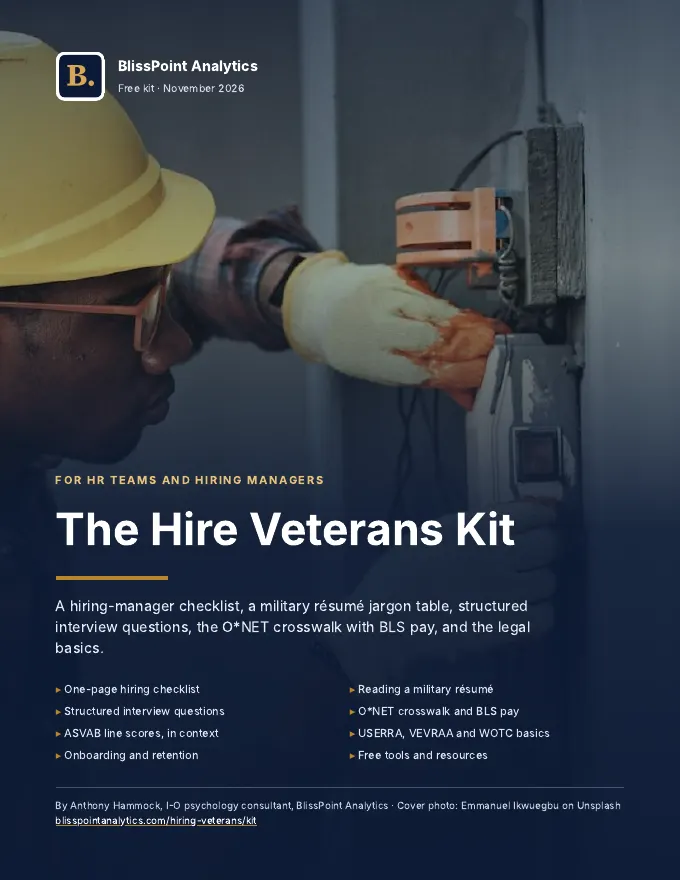
To hire veterans well, translate the military job into civilian occupations with O*NET's Military Crosswalk, read the résumé for scope and evidence, and interview every candidate with the same job-related, structured questions. The free Hire Veterans Kit puts that on paper: a one-page checklist, a jargon table, interview questions and the legal basics.
Email me the kit
Get the Hire Veterans Kit by email: a link to the 11-page PDF. No account needed.
General information, not legal or tax advice. Or open the PDF directly.
What's inside
- A one-page hiring-manager checklist, from job post to day 90
- How to read a military résumé, with a jargon translation table
- Structured interview questions with scoring anchors, and what never to ask
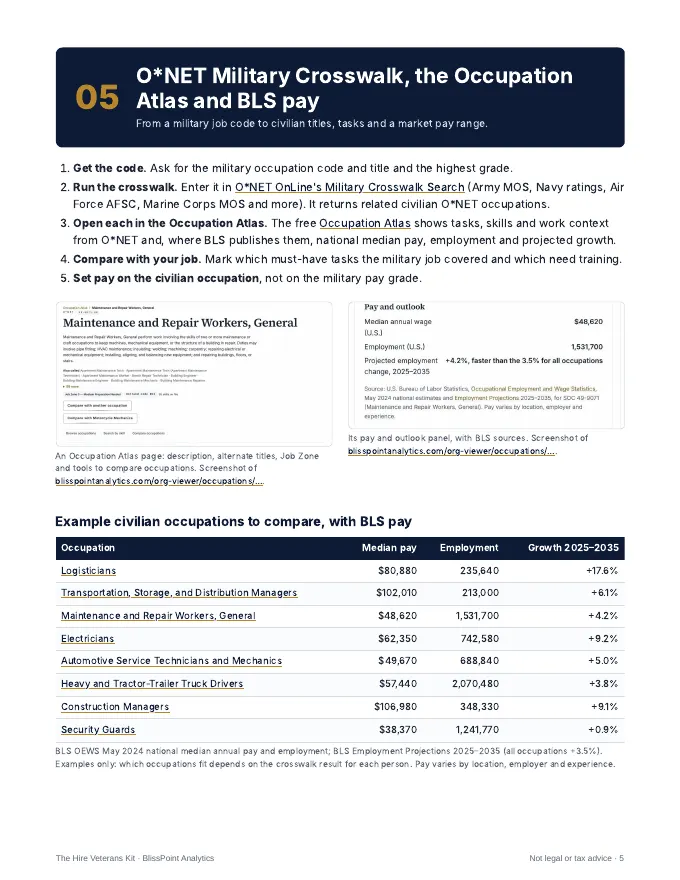
- Using the O*NET Military Crosswalk and the Occupation Atlas, with BLS pay
- ASVAB line scores as context only, with no minimum scores
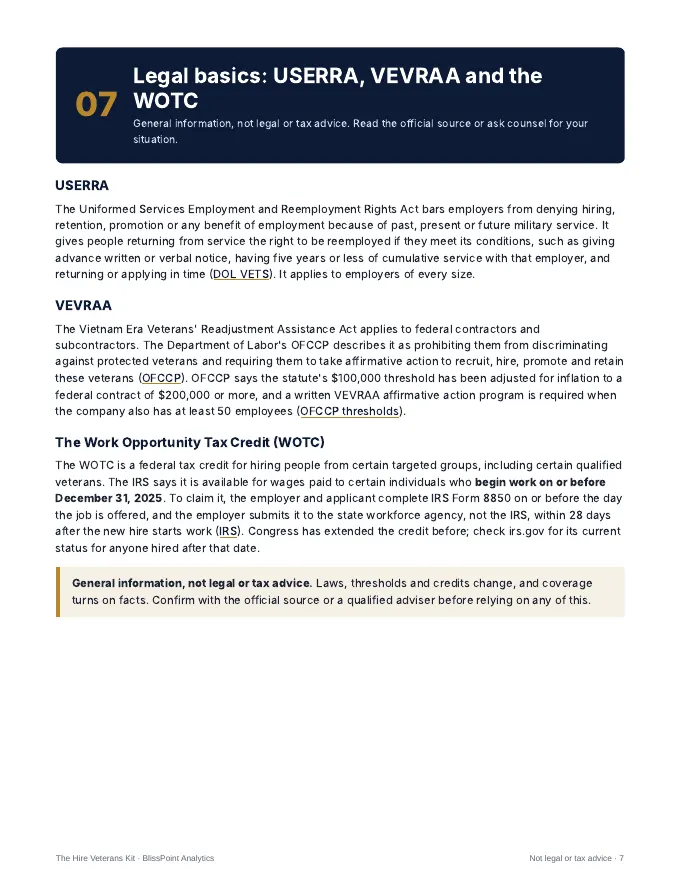
- USERRA, VEVRAA and WOTC basics (not legal or tax advice)
- Onboarding and retention tips, and free tools
Who it's for
- HR teams and recruiters writing job posts and interview guides
- Hiring managers who interview candidates with military backgrounds
- Founders and small companies hiring their first veterans
- Fractional HR consultants and PEOs advising client companies
Advise several client companies? See how fractional HR consultants and PEOs partner with us.
Preview the pages
How to hire veterans: the short version
In 2025, 17.3 million people in the United States were veterans, and their unemployment rate was 3.5 percent, against 4.2 percent for nonveterans, according to the Bureau of Labor Statistics. Many of them are looking for work your company needs done. The hard part is rarely motivation or skill; it is that military experience is written in a language most hiring processes were not built to read.
So the method is simple. Start from a job analysis: list the tasks and skills the role really needs, and drop requirements it doesn't, such as a degree where military training covers the same ground. Translate each candidate's military occupation into civilian occupations. Read the résumé for scope and evidence. Then interview every candidate, veteran or not, with the same structured, job-related questions, scored against anchors you wrote before the first interview.
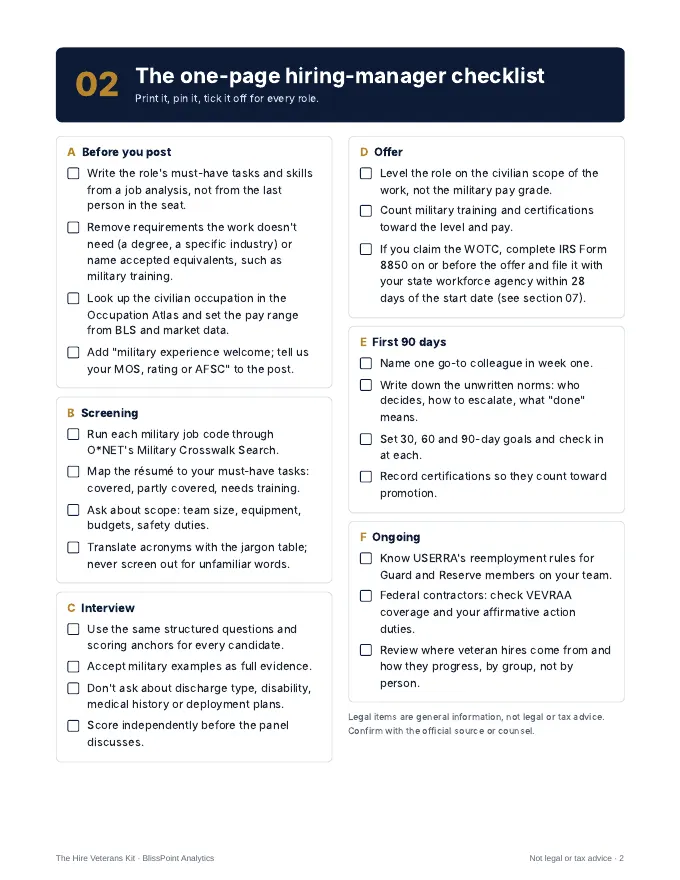
A veteran hiring checklist that fits on one page
The kit's checklist runs in six phases. Before you post: write must-have tasks, name military training as an accepted equivalent and set the pay range from the civilian occupation. Screening: run each military job code through the crosswalk and map the résumé to your must-have tasks. Interview: the same questions for everyone, military examples accepted as full evidence, independent scoring. Offer: level the role on civilian scope, not military pay grade, and count military certifications. First 90 days: a named go-to colleague, written norms and 30, 60 and 90-day goals. Ongoing: know USERRA's reemployment duties and review veteran hires' progress as a group.
Printed and pinned beside a hiring manager's desk, it keeps a good candidate from being lost to an unfamiliar acronym.
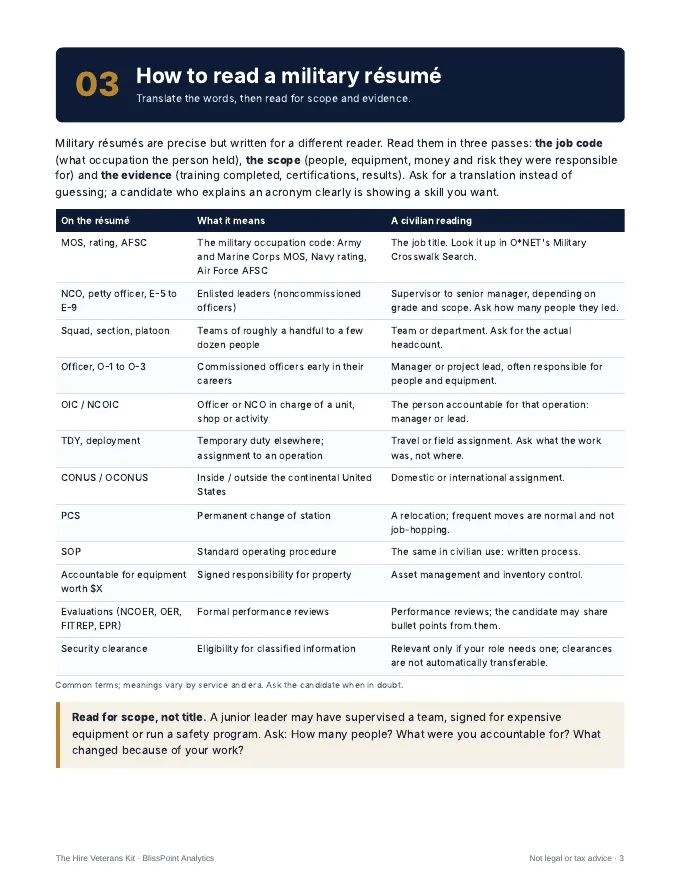
Military résumé translation
Read a military résumé in three passes. First, the job code: an Army or Marine Corps MOS, a Navy rating or an Air Force AFSC names the occupation. Enter it in O*NET's official Military Crosswalk Search to see related civilian occupations, then open those in the free Occupation Atlas to compare their tasks and skills with your job and check BLS median pay and outlook.
Second, the scope: how many people the person led, what equipment or money they signed for, what safety or compliance work they ran. A junior leader may have supervised a team and been accountable for equipment worth far more than many civilian managers handle. Third, the evidence: training completed, certifications and results. The kit's jargon table translates common terms, from NCO and OIC to PCS and TDY, into a civilian reading, so screeners ask instead of guessing.
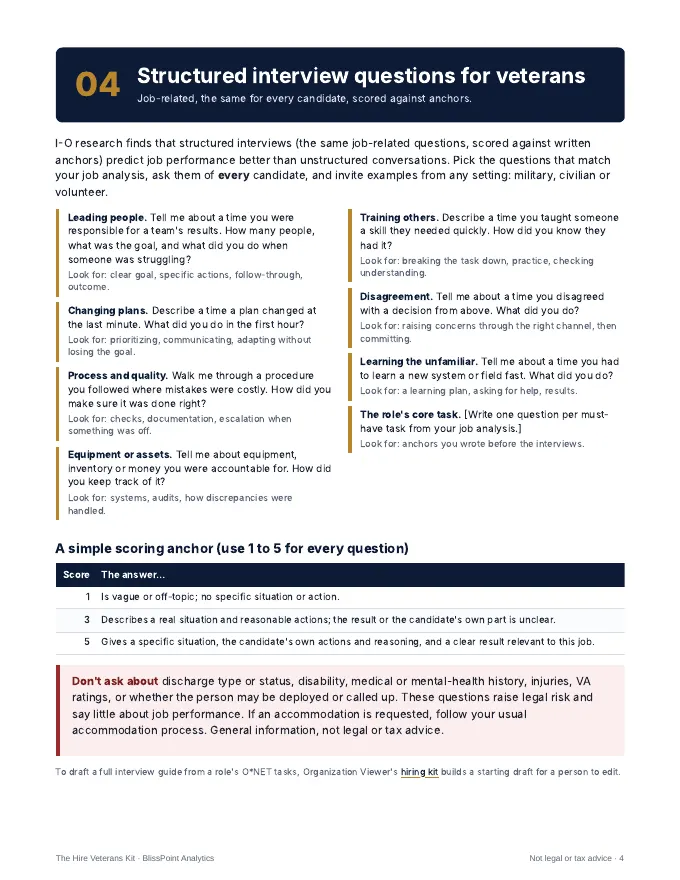
Veteran interview questions that are fair and job-related
Industrial and organizational psychology research has long found that structured interviews predict job performance better than unstructured conversations, and they matter more when a candidate's background uses unfamiliar language. The kit gives eight behavioral questions (leading people, changing plans, process and quality, accountability for assets, training others, disagreement, learning fast, and one per core task) with what to look for in an answer and a simple 1 to 5 anchor.
Just as important is what not to ask. Don't ask about discharge type or status, disability, medical or mental-health history, injuries, VA ratings, or whether the person may be deployed or called up. Those questions raise legal risk and say little about performance. If an accommodation is requested, follow your usual process. This is general information, not legal advice.
The legal basics, in plain words
USERRA bars employers of every size from denying hiring, retention, promotion or any benefit of employment because of past, present or future military service, and gives returning service members reemployment rights if they meet its conditions (DOL VETS). VEVRAA applies to federal contractors and subcontractors, with affirmative action duties (OFCCP). The Work Opportunity Tax Credit covers certain qualified veterans who begin work on or before December 31, 2025, per the IRS; check irs.gov for later hires. All of this is general information, not legal or tax advice.
ASVAB line scores appear in the kit only as context: they were built to place recruits into military training, so the kit lists no minimum scores and advises against asking for them. BlissPoint Analytics is not affiliated with the U.S. DoD; confirm with a recruiter. For more depth, read the web guide to hiring veterans, and share the free Military to Civilian Career Guide with candidates.
BlissPoint Analytics is not affiliated with the U.S. DoD, any military service or the ASVAB program. Confirm with a recruiter.
Read the hiring veterans guideOpen the Occupation Atlas
Questions
How do you hire veterans?
Write the job's must-have tasks from a job analysis, translate each candidate's military occupation with O*NET's Military Crosswalk Search, read the résumé for scope and evidence, and interview every candidate with the same structured, job-related questions scored against written anchors.
What should a veteran hiring checklist include?
Job requirements that the work really needs, a crosswalk lookup for each military job code, a jargon translation, structured interview questions, pay set on the civilian occupation, and a 90-day onboarding plan with a named contact. The kit's checklist fits on one page.
What interview questions should I not ask a veteran?
Don't ask about discharge type or status, disability, medical or mental-health history, injuries, VA ratings, or whether the person may be deployed or called up. Ask job-related behavioral questions instead. This is general information, not legal advice.
Should employers ask for ASVAB scores?
No. ASVAB line scores were built to place recruits into military training and may be years old. The kit treats them as context only and lists no minimum scores. BlissPoint Analytics is not affiliated with the U.S. DoD; confirm with a recruiter.
Is the Work Opportunity Tax Credit still available for veterans?
The IRS says the WOTC is available for wages paid to certain individuals who begin work on or before December 31, 2025. Congress has extended it before, so check irs.gov for later hires. This is general information, not tax advice.
Is the kit free?
Yes. Enter your email and we send a link to the PDF. The updates box is separate and unchecked; the kit sends either way.