


What is OCCU-Find?
OCCU-Find, the career search in the ASVAB Career Exploration Program, matches interest codes and Career Exploration Scores to occupations. To turn that into a plan, shortlist occupations from your top interest codes, read their tasks in O*NET, check BLS pay and outlook, and choose a training path. This free guide walks through six steps, with worksheets.
Written for students, parents and counselors. Access to OCCU-Find comes through the official program at asvabprogram.com and the student's school or counselor; this guide never lists access codes. BlissPoint Analytics is not affiliated with the U.S. DoD, any military service or the ASVAB program. Formulas and job requirements change, so confirm with a recruiter.
OCCU-Find is the occupation search in the ASVAB Career Exploration Program (CEP), a free career planning program the Department of Defense offers through high schools. It groups more than 400 occupations by the six RIASEC interest types and shows how important verbal, math, and science and technical skills are to each, with education and related military careers. Students reach it at asvabprogram.com with the access code on their ASVAB Summary Results sheet; if it is lost, the school counselor or test coordinator can help. This guide never lists or guesses access codes.
Taking the CEP ASVAB does not commit anyone to military service. BlissPoint Analytics is not affiliated with the U.S. DoD, any military service or the ASVAB program. Formulas and job requirements change, so confirm with a recruiter.
From OCCU-Find results to a career plan in six steps
OCCU-Find is a great start, and it is not a plan. The guide's six steps close the gap.
Steps 1 to 3: interests, skills and a shortlist
Write down your top three interest codes from the Find Your Interests inventory. Note your three Career Exploration Scores and treat them as a guide to what to learn next, not a ceiling. Then shortlist five occupations that fit your top codes, including one you have never heard of.
Steps 4 and 5: O*NET and BLS
Open each in the free Occupation Atlas, built on O*NET, and read the tasks, work context, skills and Job Zone. Then check median pay, number of jobs and projected growth against the +3.5% average. Registered nurses, for example, earn a median $93,600 with growth of +5.6% and 3,282,010 jobs.
Step 6: a training path
For your top two, list the routes in, from four-year college and community college to apprenticeship, military training and certificates, then write one concrete next step and a date.
The six interest types, with growing examples
Realistic types like hands-on work with tools and machines; the guide's example is heavy and tractor-trailer truck drivers ($57,440). Investigative types like research and problem solving: neurodiagnostic technologists. Social types like helping and teaching: preschool teachers. Enterprising types like leading and persuading. Conventional types like data, records and set procedures: pharmacy technicians (+6.4%). Most people have a top two or three codes, so look at occupations that match two together.
Compare paths on pay and outlook
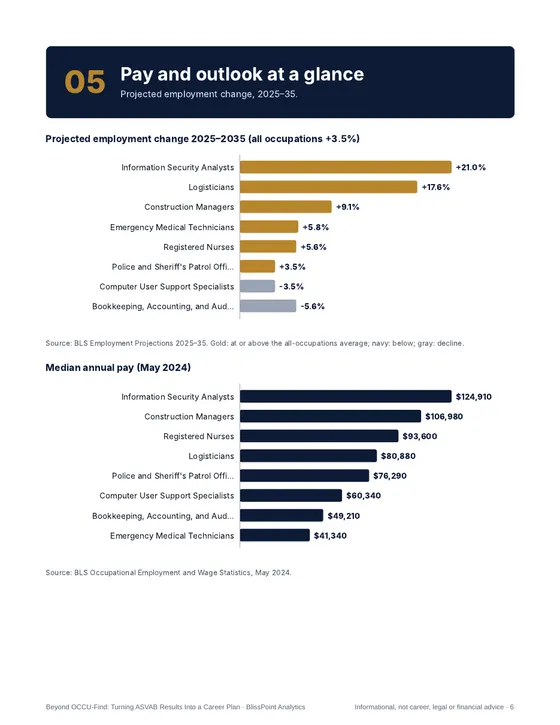
The guide compares eight paths side by side. Information security analysts lead on growth (+21.0%) and pay ($124,910); logisticians (+17.6%) and construction managers (+9.1%) follow. Some fields are projected to shrink, such as bookkeeping clerks (−5.6%), which is why outlook is worth checking before committing. A big field with modest growth can still have many openings.
For counselors and parents
Run the worksheets across two sessions: interests, skills and a shortlist first, then pay, outlook and one concrete step. Parents can join the second. Ask what a student liked about each job, not only what it pays, then help with the next step: a job-shadow day, a campus visit or a call to an apprenticeship sponsor. If military jobs are on the list, the Complete ASVAB Line Score Guide explains each score, and the free explainer What is ASVAB OCCU-Find? covers the program in more detail.
Informational, not career, legal or financial advice. BlissPoint Analytics is not affiliated with the U.S. DoD, any military service or the ASVAB program. Formulas and job requirements change, so confirm with a recruiter.
Frequently asked questions
What is OCCU-Find?
The occupation search in the ASVAB Career Exploration Program. It groups more than 400 occupations by the six RIASEC interest types and shows how important verbal, math, and science and technical skills are to each.
How do I get an OCCU-Find access code?
Through the official program: the code is on the student's ASVAB Summary Results sheet, and the school counselor or test coordinator can help if it is lost. This guide does not list or guess codes.
Does taking the CEP ASVAB commit a student to the military?
No. The Career Exploration Program is a career planning program, and OCCU-Find includes civilian occupations as well as military ones.
Can counselors use the worksheets?
Yes. The three worksheets are designed to print and fill in across two sessions: interests and a shortlist, then pay, outlook and one concrete next step.
What are the six RIASEC interest types?
Realistic, Investigative, Artistic, Social, Enterprising and Conventional, from John Holland's theory of career choice. The FYI inventory gives a student's top codes; most people have a top two or three.
How do you turn OCCU-Find results into a career plan?
Write down your top interest codes and Career Exploration Scores, shortlist five occupations, read each in O*NET, check BLS pay and outlook, and choose a training path with one next step and a date. The guide's worksheets walk through each step.