
AI red teaming course comparison: how this course compares with OSCP, AIGP and others
Offensive Security and AI Red Teaming for People Systems is for security engineers moving into AI, and for HR-tech, people-analytics and AI governance leads who build, buy or audit hiring tools. What makes it different: it teaches AI security and red teaming together with I-O psychology fairness and validity for hiring tools, from adverse impact statistics to an NYC Local Law 144 bias audit. None of the programs compared below covers that.
Course overview · Full syllabus · Free preview lesson · Glossary
Who is this comparison for?
- Security engineers weighing OSCP or other red teaming coursesRead it to see what this course adds on AI security and hiring-tool fairness.
- AI governance leads considering AIGPRead it to compare a governance credential with hands-on testing of hiring tools.
- Managers choosing training for a teamRead it to see which programs cover both security testing and fairness auditing.
Why choose this course
It's the only course we found built around the question employers and regulators now ask: “Is our AI hiring tool secure, fair and defensible?”
- A security course teaches you to break the tool.
- An AI governance course teaches you the policies.
- This one teaches both, plus the employment-testing science that courts and regulators use.
It's taught by an I-O psychology consultant, at about a tenth of the price of a SANS AI security course (Core tier), with nothing to install. SANS SEC545: $8,260 to $8,375 per course, by delivery format. Source: SANS SEC545 course page, checked 2026-11-07.
Read the page for your role: For HR tech and people-analytics teams · For security professionals moving into AI · For I-O psychology and HR professionals · Free resources · AI security and AI audit careers
Skills you will gain, by track
Each skill is a learning objective of the module that teaches it, taken from the syllabus.
Core track
Module 0: Security foundations: networking, operating systems and cryptography
- Analyze the path of an HTTPS request from an HR user to an AI vendor's API, identifying each layer, address translation, proxy and trust boundary, and what an observer can see at each hop (assessed: Lesson 01 checks and lab, quiz m00-q1 to m00-q4, assignment Part A).
- Evaluate Linux and Windows permission settings on files, services and logs that hold candidate data, and justify least-privilege corrections (assessed: Lesson 02 checks and lab, quiz m00-q5 to m00-q8, assignment Part B).
- Evaluate whether a proposed use of hashing, MACs, AES-GCM, signatures, password hashing or TLS meets a stated confidentiality, integrity or authenticity goal, and diagnose common misuse such as IV reuse and fast password hashes (assessed: Lesson 03 checks and lab, quiz m00-q9 to m00-q13, assignment Part C).
- Design a secure data-sharing and credential-verification process for people data that combines minimization, keyed pseudonymization, encryption, signatures and key management (assessed: Lesson 03 worked and independent examples, assignment Part C).
- Assess your own readiness for later modules by measuring calibration on a diagnostic and create a study plan mapped to the course's dependency graph (assessed: Lesson 04 checks and lab, quiz m00-q14, assignment Part D).
Module 1: Foundations: the security mindset, threat modeling, law and methodology
- Analyze a people-data system to identify its assets, attack surface and trust boundaries, and justify which CIA property matters most for each asset
- Construct a STRIDE-based threat model and a quantified attack tree for an AI hiring workflow, and evaluate how sensitive its conclusions are to expert estimates
- Evaluate whether a proposed security test is lawful and ethical by applying the CFAA's key definitions and the authority, scope, window and method conditions
- Create an authorization package with scope, rules of engagement and a data-handling clause modeled on NIST SP 800-115 Appendix B
- Compare NIST SP 800-115, the OWASP WSTG, OSSTMM and PTES, critique each one's limits, and design a combined test plan for a given system
Module 2: Reconnaissance and network penetration testing
- Analyze an organization's public footprint, including job postings and recruiter profiles, and map findings to ATT&CK Reconnaissance techniques
- Evaluate the strength of combined OSINT evidence using prior odds and likelihood ratios
- Interpret Nmap's six port states and explain the packet-level mechanism behind SYN, connect and UDP scan results
- Design a scan plan that fits a test window and rules of engagement, using explicit estimates of scan time and miss probability
- Evaluate vulnerability scanner output using base rates and positive predictive value, and create a prioritized finding list that combines CVSS v4.0, EPSS and business impact
Module 3: Active Directory security: authentication, detection and hardening
- Analyze Kerberos and NTLM exchanges and identify which key protects each message and which audit event each step produces
- Analyze an AD configuration to identify the preconditions for Kerberoasting, AS-REP Roasting, delegation abuse, ACL abuse and credential theft, citing ATT&CK technique IDs
- Create and evaluate a detection for anomalous service-ticket requests, including an explicit estimate of its false-alarm rate
- Evaluate permission paths to Tier 0 as a graph-reachability problem and prioritize remediation by minimum cut
- Create a staged, measurable hardening plan using tiering, Protected Users, gMSA, Windows LAPS, RC4 removal and delegation hygiene
Module 4: Web application security
- Evaluate the OWASP Top 10 as an evidence source, including its incidence metric, selection bias and the 2021-to-2025 changes
- Create a test plan that maps Top 10 categories to WSTG test IDs, features and evidence for an HR web application
- Analyze injection as a change in parse structure and justify why parameterization prevents it by construction
- Evaluate SSRF defenses, including allow-lists, post-resolution validation and egress control, and quantify deny-list weakness
- Analyze authentication, session and access-control designs using session entropy and a role-action-object policy matrix
- Evaluate an API against the OWASP API Security Top 10 (2023), distinguishing object-, property- and function-level authorization failures and designing an API inventory for a hiring integration (assessed: Lesson 04 checks and lab, quiz q13-q15).
Module 5: Exploitation, privilege escalation and post-exploitation (concepts)
- Analyze a component's trust boundaries and inputs to classify a candidate bug as memory-safety or logic/injection and identify the primitive it yields (assessed: Lesson 01 checks, quiz q1-q3, assignment Part A).
- Evaluate the combined effect of layered mitigations using a probabilistic model, and critique that model's independence assumption (assessed: Lesson 01 check c2, quiz q4).
- Analyze a host as a privilege graph and identify the minimal set of edges to cut to prevent escalation to root or SYSTEM (assessed: Lesson 02 worked/faded examples, quiz q5-q7, assignment Part B).
- Map escalation, persistence and lateral-movement findings to current MITRE ATT&CK techniques and justify each mapping (assessed: Lesson 02 check c2, quiz q8-q9, assignment Parts B-C).
- Design detections and segmentation that lengthen the attack path and raise detection probability for an HR platform (assessed: Lesson 03 lab, quiz q10-q12, assignment Part C).
Module 6: Professional practice: scoping, authorization, CVSS v4.0, reporting and insurance
- Design a scope and rules of engagement for an AI-enabled HR platform that keeps every planned action within authorized targets, including third-party and candidate protections (assessed: Lesson 01 checks, quiz q1-q4, assignment Part A).
- Evaluate who has authority to approve testing of a given asset and identify gaps in an authorization chain (assessed: Lesson 01 check c1, quiz q2).
- Apply CVSS v4.0 Base, Threat and Environmental metrics to findings, justify each value from the specification, and critique what the score omits (assessed: Lesson 02 checks, quiz q5-q9, assignment Part B).
- Create executive and technical reports whose findings separate symptoms from root causes and provide layered recommendations (assessed: Lesson 03 worked/faded examples, quiz q10-q11, assignment Part C).
- Analyze re-test data with a two-proportion test to judge whether remediation reduced attack success (assessed: Lesson 03 check c3, quiz q12, assignment Part C).
- Design a vulnerability-management program that combines asset inventory, CVSS v4.0, EPSS and the CISA KEV catalog with asset context, and evaluate a prioritization rule by coverage, efficiency and effort (assessed: Lesson 04 checks and lab, quiz q13-q15).
Module 7: Machine learning and LLM foundations for security people
- Apply basic Python in a hosted notebook (variables, lists and dictionaries, functions, pandas tables and web API calls) to read, run and adapt an audit analysis such as group selection rates (assessed: Lesson 00 checks and lab, quiz q13-q14).
- Explain, from the attention and sampling equations, why an LLM cannot by construction distinguish developer instructions from untrusted text, and analyze the security consequences (assessed: Lesson 01 checks, quiz q1-q4, assignment Part A).
- Evaluate the security trade-offs of fine-tuning, preference training, LoRA adapters and RAG for an HR use case, citing primary research (assessed: Lesson 02 checks, quiz q5-q8, assignment Part B).
- Analyze embedding-based retrieval for leakage, poisoning and access-control failures, and design retrieval-time controls (assessed: Lesson 02 lab, quiz q7-q8, assignment Part B).
- Create a data-flow diagram with trust boundaries for an LLM agent and map each boundary crossing to OWASP LLM Top 10 2025 items (assessed: Lesson 03 lab, quiz q9-q11, assignment Part C).
- Design a tool policy that applies least privilege, complete mediation and human approval to an HR agent, and critique its residual risk (assessed: Lesson 03 worked/faded examples, quiz q12, assignment Part C).
Module 8: OWASP Top 10 for LLM Applications (2025): deep dive
- Configure an intentionally vulnerable LLM application (the ToyScreen starter or the hosted labs) and apply an experimental protocol that measures attack success rates with confidence intervals by switching one weakness at a time (assessed: Lesson 01 lab, quiz q1, assignment Part A).
- Analyze each OWASP LLM Top 10 2025 item's mechanism, using primary research (for example Greshake et al. 2023 for indirect injection; Zou et al. 2023 for adversarial suffixes), and explain why prompt-level controls are insufficient (assessed: Lessons 02-11 checks, quiz q2-q11, assignment Part B).
- Evaluate defenses for each item by controlled before/after experiments on ToyScreen, including false-positive rates by group (assessed: Lessons 02-11 labs, assignment Part B).
- Design a layered defense architecture that mixes model, prompt, filter, architectural, human and monitoring controls, and critique its correlated failure modes with ablation and adaptive testing (assessed: Lesson 12, quiz q12-q14, assignment Part C).
- Evaluate how each LLM risk threatens the validity, fairness and auditability of a selection procedure, and specify records that allow affected candidates to be identified and re-reviewed (assessed: 'In people systems' sections, quiz q15, assignment Part D).
Module 9: Adversarial machine learning theory
- Formulate evasion, poisoning and backdoor attacks as constrained optimization problems and explain each symbol in plain words (analyze).
- Compute FGSM and PGD perturbations, poisoning effects and extraction results by hand for linear models, and verify them with a spreadsheet, the course's ready-written notebooks or, optionally, your own code against models you own (apply/analyze).
- Evaluate a vendor's robustness or privacy claim by identifying its threat model, its metric and the attacks it omits (evaluate).
- Interpret (ε, δ)-differential privacy and randomized-smoothing certificates, including what they do not guarantee (evaluate).
- Classify any adversarial ML finding using the NIST AI 100-2 E2025 taxonomy and the matching MITRE ATLAS technique (analyze).
- Design a threat-model-driven robustness and privacy test plan for an AI hiring model (create).
Module 10: MITRE ATT&CK and ATLAS
- Analyze an incident or red-team finding and map each step to the correct, version-pinned ATT&CK or ATLAS tactic and technique, with written reasoning (analyze).
- Explain the structure of ATT&CK (tactics, techniques, sub-techniques, procedures, detection strategies, analytics, data components) and of ATLAS (tactics, techniques, maturity, mitigations, case studies), including changes in ATT&CK v18–v20 and ATLAS 2026.10 (understand/analyze).
- Evaluate an ATLAS case study to identify choke points and the controls that would break the chain (evaluate).
- Critique coverage claims and detection metrics using precision, recall, base rates and inter-rater agreement (evaluate).
- Design and test a detection for an AI-specific technique against a lab application, written as detection-as-code (create).
Module 11: AI red teaming in practice
- Design a scoped, authorized AI red-team campaign with a threat model, harm taxonomy, operational success definitions and a test-plan matrix (create).
- Configure and run garak, PyRIT and promptfoo against a model and an application you own, and justify which tool fits each part of a campaign (apply/evaluate).
- Build adaptive multi-turn attacks and ground-truth scorers, and keep results auditable with persistent, labeled logs (create).
- Design a two-tier CI pipeline that turns confirmed findings into regression gates without exposing secrets, data or budget (create).
- Estimate, compare and report attack success rates with appropriate units, confidence intervals, clustering adjustments, judge-error correction and paired tests (evaluate).
Module 12: Frameworks and governance
- Analyze an AI hiring tool against the four functions of the NIST AI RMF and write a current and target profile with evidence for each relevant subcategory.
- Differentiate outcome frameworks (CSF 2.0, AI RMF), control catalogs (SP 800-53 Rev. 5) and management-system standards (ISO/IEC 42001), and evaluate what evidence each can and cannot provide about a specific system.
- Classify a hiring or people-analytics system under Article 6 and Annex III of the EU AI Act, including the profiling override, and determine which obligations apply and from which date under the 2026 amendments.
- Evaluate whether a tool is an AEDT under NYC Local Law 144 and design a compliant bias-audit, publication and notice process.
- Assess the current status of a fast-changing state AI law from primary sources and document clearly what could not be verified.
- Construct a versioned crosswalk across seven governance documents, grade each link's strength, and create a minimum-cost evidence plan from it.
- Analyze a vendor's SOC 2 report (scope, opinion, exceptions, carve-outs and complementary user entity controls) and evaluate what it can and cannot show about an AI hiring tool, including why it never substitutes for a bias audit or validity evidence.
- Construct a FAIR-style Monte Carlo risk model for an HR system, interpret its loss distribution and exceedance probabilities, critique its limits, and evaluate a business impact analysis using NIST SP 800-34 MTD, RTO and RPO (assessed: Lesson 07 checks and lab, quiz q17-q18).
Module 13: Fairness and validity of AI hiring tools
- Calculate selection rates and impact ratios at each stage of a hiring funnel and evaluate them against 29 CFR 1607.4(D), including its qualifications for significance, small numbers and the bottom line.
- Apply and justify the choice between a two-proportion z-test and Fisher's exact test, construct confidence intervals for impact ratios, and analyze statistical power to judge what a non-significant result can show.
- Evaluate a vendor's validity evidence for an AI screener using the five sources of evidence in the Standards, the SIOP Principles and the Uniform Guidelines' validation strategies, including range restriction and differential prediction.
- Design and analyze a pre-registered paired (counterfactual) test of an AI screener using McNemar's test and paired score differences, and critique its limits.
- Explain the Kleinberg et al. (2016) and Chouldechova (2017) impossibility results, derive their consequence for selection rates, and justify a documented choice among alternative configurations.
- Create an LL144 bias-audit table set (sex, race/ethnicity, intersectional) with unknowns, the 2% exclusion and sensitivity bounds.
Module 14: Capstone: a full AI hiring tool security and fairness audit
- Analyze a hosted, deliberately vulnerable AI screening app against a reference specification of planted security, fairness and validity flaws, stating testable hypotheses before testing.
- Construct a statement of work, authorization to test, rules of engagement and test plan that handle vendor consent, personal data and live-pipeline risks.
- Design quantitative pass/fail criteria and sample sizes for security and fairness tests before execution.
- Execute and evaluate security, adverse-impact, paired-testing, validity and reliability workstreams under configuration control, and rate findings on security and people-impact axes.
- Evaluate fixes through re-testing against pre-set criteria and recommend a monitoring plan.
- Create a two-audience audit report with evidence-backed findings, framework mapping and an LL144-style summary of results.
Module 26: Career ladder and leadership: from entry level to principal and CISO in AI security
- Analyze job postings and organizational ladders to place a role on a level and track, using job analysis, the NICE Framework and O*NET (assessed: Lesson 01 checks, quiz q1-q3, assignment Part A).
- Evaluate your own competencies against behaviorally anchored level descriptors with evidence and a second rater, and identify the gaps to a target level under conjunctive scoring (assessed: Lesson 02 checks, quiz q4-q6, assignment Part B).
- Create a portfolio-of-proof map and a 12-month development plan grounded in research on practice, feedback, goal setting and implementation intentions (assessed: Lesson 02 checks, quiz q6, assignment Parts C and D).
- Evaluate hiring and promotion processes from both sides, using selection-validity research, and construct an evidence-based promotion case or structured interview (assessed: Lessons 03 and 05 checks, quiz q7-q8 and q11, assignment Part E).
- Evaluate pay information for source, date and scope, and design an evidence-based negotiation plan (assessed: Lesson 04 checks, quiz q9-q10, assignment Part E).
- Design an AI security program and board report around the NIST CSF 2.0 Govern Function, or an independent practice with sound scoping, pricing, independence and insurance safeguards (assessed: Lessons 05-06 checks, quiz q11-q14, assignment Part E).
Module 99: Appendix: certification paths
- Evaluate certifications by what their format actually assesses (knowledge, hands-on performance, governance) rather than by reputation.
- Create a dated, source-linked certification plan and budget, verifying every price and format on the official page.
- Analyze how course modules map to each certification's published objectives and identify gaps.
Expert track
Module 15: Agentic AI security
- Analyze an agent architecture, including MCP hosts, clients and servers, and draw its trust boundaries and capability chains (assessed: Lesson 01 checks and lab, quiz q1-q4, assignment Part A).
- Evaluate an agent design for indirect prompt injection, confused-deputy, token-passthrough and excessive-agency risks, citing the MCP specification and OWASP LLM06:2025 (assessed: Lesson 02 checks and lab, quiz q5-q9, assignment Part B).
- Create a layered containment design (pattern, least privilege, sandbox, human-in-the-loop, monitoring) for an HR agent and critique its residual risk (assessed: Lesson 03 checks and lab, quiz q10-q12, assignment Part C).
- Evaluate the effect of a control with a measured attack success rate and interval, distinguishing guarantees from statistical reductions (assessed: Lesson 02-03 labs, assignment Part D).
Module 16: Measurement science for AI evaluation
- Evaluate the reliability of a red-team metric by computing test-retest flip rates and chance-corrected inter-rater agreement (Cohen's kappa), and judge whether it supports the intended decision (assessed: Lesson 01 checks, quiz q1-q3, assignment Part A).
- Analyze an AI evaluation claim with an interpretation/use argument and the five sources of validity evidence, identifying construct underrepresentation, construct-irrelevant variance, non-invariance and contamination (assessed: Lesson 02 checks, quiz q4-q7, assignment Part B).
- Calculate and critique confidence intervals for attack success rate that account for clustering, prompt variance and nondeterminism, and compare two systems with paired tests (assessed: Lesson 03 checks, quiz q8-q11, assignment Part C).
- Design a validation study for an AI security or fairness audit using seeded defects, inter-auditor agreement, judge calibration and decision-accuracy analysis (assessed: Lesson 04 checks, quiz q12-q14, assignment Part D).
- Evaluate an LLM judge as a measurement instrument using chance-corrected agreement, bias probes and calibration error, and critique post-hoc explanations (LIME, SHAP) as sources of adverse-action reasons (assessed: Lesson 05 checks and lab, quiz q15-q17).
Module 17: Cloud and identity security
- Analyze effective permissions in AWS, Azure and Google Cloud by applying each provider's evaluation logic, and assign responsibility under the shared-responsibility model (assessed: Lesson 01 checks and lab, quiz q1-q4, assignment Part A).
- Evaluate an OAuth 2.0, OIDC or SAML integration against RFC 6749, RFC 7636, RFC 9700 and OIDC Core validation rules, and design a secure token flow for an AI agent (assessed: Lesson 02 checks and lab, quiz q5-q9, assignment Part B).
- Create a secrets and misconfiguration assessment that maps each finding to a verified ATT&CK technique with a tested detection (assessed: Lesson 03 checks and lab, quiz q10-q12, assignment Part C).
- Design a zero trust architecture for HR data that applies the NIST SP 800-207 tenets and logical components, and critique a trust algorithm's signals, thresholds and blind spots (assessed: Lesson 04 checks and lab, quiz q13-q14).
- Evaluate a Kubernetes deployment of an AI workload across image provenance, namespaces, RBAC, Pod Security Standards, network policies and Secrets, and prioritize hardening findings (assessed: Lesson 05 checks and lab, quiz q15-q16).
Module 18: Secure ML Engineering and MLOps
- Analyze an ML system's supply chain and identify where tampering, spoofing and repudiation threats arise.
- Evaluate a model release process against SLSA Build levels and recommend the controls needed to reach a target level.
- Create a signed model manifest and a CycloneDX ML-BOM for a model you own, and verify them at deployment.
- Evaluate model serialization formats for code-execution risk and justify a format policy.
- Design integrity controls (hashing, lineage, validation) for a training data pipeline.
- Create testable, prioritized remediation recommendations for an ML deployment.
- Evaluate a development process against the NIST SSDF (SP 800-218) and its AI profile (SP 800-218A), and design a review and testing plan that combines threat modeling, code review, SAST, DAST and SCA (assessed: Lesson 04 checks and lab, quiz q11-q13).
Module 19: Privacy Engineering and Employment Data Law
- Analyze whether an AI hiring workflow engages GDPR Article 22, applying the elements and the CJEU's SCHUFA reasoning.
- Evaluate the currency and binding force of legal sources, distinguishing statutes and regulations from withdrawn agency guidance.
- Analyze which US privacy, biometric and employment laws a given AI hiring tool triggers across jurisdictions.
- Evaluate de-identification claims against linkage attacks, k-anonymity limits and differential privacy trade-offs.
- Create a four-part GDPR Article 35(7) DPIA for an AI hiring tool, with testable measures.
Module 20: Detection Engineering and AI Incident Response
- Design a privacy-aware telemetry schema for an LLM application and evaluate its data coverage against a technique list.
- Evaluate a prompt injection classifier using TPR, FPR and base rates, and justify how it should be used.
- Create Sigma detection rules with tests and a detection-as-code lifecycle.
- Analyze an AI incident and map response steps to NIST SP 800-61r3 CSF 2.0 Subcategories and AI RMF outcomes.
- Create and facilitate a tabletop exercise for an AI hiring incident and produce an after-action report.
Module 21: Statistics for fairness audits
- Calculate the sample size and power needed to detect a specified impact ratio at a given baseline rate, and evaluate whether a published audit was adequately powered (assessed: Lesson 01 checks, quiz q1-q3, assignment Part A).
- Construct and interpret confidence intervals for impact ratios and write findings that claim only what the interval supports (assessed: Lesson 01 checks c3-c4, quiz q4, assignment Part A).
- Select between exact and large-sample tests and design a multiple-comparisons strategy across stages and intersectional groups, justifying the family and error rate (assessed: Lesson 02 checks, quiz q5-q7, assignment Part B).
- Analyze the standard deviation reasoning in Castaneda and Hazelwood, reproduce the Court's arithmetic, and critique regression models that control for mediators or tool outputs (assessed: Lesson 03 checks, quiz q8-q10, assignment Part C).
- Create a reproducible analysis package with a dated plan, Bayesian sensitivity analysis and a one-command rebuild (assessed: Lesson 04 checks, quiz q11-q12, assignment Part D).
Module 22: Expert practice: testimony, disclosure, independence and research
- Evaluate whether an expert opinion satisfies each requirement of FRE 702 as amended in 2023 and the Daubert, Joiner and Kumho Tire decisions (assessed: Lesson 01 checks, quiz q1-q4, assignment Part A).
- Create an audit or expert report whose opinions are traceable to data and method and that pre-empts common rebuttal attacks (assessed: Lesson 02 checks, quiz q5-q6, assignment Part B).
- Design a coordinated vulnerability disclosure for a security or fairness flaw in an AI hiring product (assessed: Lesson 03 checks, quiz q7-q9, assignment Part C).
- Analyze conflicts of interest and independence threats, including under the LL144 independent-auditor definition, and design safeguards (assessed: Lesson 04 checks, quiz q10-q11, assignment Part D).
- Create a research agenda with linked questions, verifiable methods and appropriate peer-review routes (assessed: Lesson 04 lab, quiz q12, assignment Part D).
Module 23: Practicum: three mock audits, a labs log and a portfolio
- Design a scoped, pre-registered audit plan and threat model for an AI hiring system (assessed: Lessons 01-03 labs, quiz q1-q3, assignment).
- Evaluate an LLM screener for prompt injection, leakage, excessive agency and name-based disparity using paired counterfactual tests (assessed: Lesson 01 checks, quiz q4-q5, assignment).
- Analyze an agent's tool authorization, output handling and resource limits, separating model-manipulation rates from access-control failures (assessed: Lesson 02 checks, quiz q6-q8, assignment).
- Analyze a tabular scorer for adverse impact, proxy features and membership-inference leakage, and frame validity questions (assessed: Lesson 03 checks, quiz q9-q11, assignment).
- Create a labs log and portfolio that provide verifiable evidence of skill while respecting platform rules (assessed: Lesson 04 checks, quiz q12, assignment).
Module 24: Authority Accelerator: becoming a recognized voice in AI hiring tool security and fairness
- Create a precise positioning statement backed only by verifiable proof points (assessed: Lesson 01 checks, quiz q1-q2, assignment Part A).
- Create an open, versioned audit framework that crosswalks OWASP, MITRE ATLAS, NIST AI RMF and AI 600-1, the Uniform Guidelines, NYC LL144, the EU AI Act Annex III and the SIOP Principles, with honest gaps (assessed: Lesson 02 checks, quiz q3-q4, assignment Part B).
- Design a pre-registered, powered and ethically scoped counterfactual-resume study of self-hosted open-weight LLMs (assessed: Lesson 03 checks, quiz q5-q6, assignment Part C).
- Design a defensive open-source test harness with safe defaults and a tested adverse-impact calculator (assessed: Lesson 04 checks, quiz q7, assignment Part C).
- Evaluate public-comment, speaking and media opportunities against primary sources and produce submissions that are specific and honest (assessed: Lessons 05-06 checks, quiz q8-q10, assignment Part D).
- Evaluate the ethics of discounted pilot audits and credential claims, and design a measurement plan using indicators others control (assessed: Lessons 07-09 checks, quiz q11-q14, assignment Part E).
Module 25: Hiring fraud, identity and insider risk in people systems
- Analyze a candidate-fraud signal's sensitivity, false positive rate and positive predictive value at a stated base rate, and evaluate its error rates by group as a selection procedure under Title VII and the ADA (assessed: Lesson 01 checks c2-c3, quiz q1-q3, assignment Parts B and D).
- Evaluate hiring-fraud controls for effectiveness, lawfulness and accessibility, and design a defensive interview and onboarding process that places intrusive checks late in the funnel (assessed: Lesson 01 checks c1 and c4, quiz q4, assignment Part A).
- Evaluate an identity verification vendor against NIST SP 800-63A-4's biometric, demographic-performance and injection-detection requirements, and create a role-based identity assurance (IAL and AAL) mapping (assessed: Lesson 02 checks, quiz q5-q7, assignment Part C).
- Analyze HRIS access data for separation-of-duties conflicts and joiner-mover-leaver failures, and design an insider risk program that applies organizational justice research and respects monitoring law (assessed: Lesson 03 checks, quiz q8-q10, assignment Part E).
- Create a STRIDE threat model of an ATS-HRIS-assessment-vendor integration and evaluate SCIM, SSO, API-token and webhook configurations against RFC 7644, OIDC Core, RFC 9700 and the Standard Webhooks specification (assessed: Lesson 04 checks, quiz q11-q13, assignment Part F).
Specialist add-on
Module 27: Exploit Development Foundations: Memory Safety, Mitigations and Vulnerability Research
- Analyze C code and sanitizer reports to classify memory-safety bugs by CWE ID and state the primitive each gives.
- Evaluate a binary's build hardening and explain, with a probability model, which attacker steps each mitigation removes and which remain.
- Create a fuzz harness for a parser, triage and root-cause the crashes it finds, and write an evidence-matched, CWE-mapped and CVSS v4.0-scored report suitable for coordinated disclosure.
- Evaluate a fuzzing comparison using multiple trials and the Vargha–Delaney A12 statistic.
- Design a model intake and sandboxed inference standard that addresses unsafe deserialization and native-library risk in an AI hiring system.
Module 28: Malware Analysis and Reverse Engineering Foundations
- Analyze a published malware or AI-attack report and map its behaviors to MITRE ATT&CK and ATLAS techniques with the data source needed to observe each.
- Evaluate an organization's handling of suspicious files, including candidate documents and model files, against isolation, legal, ethical and privacy requirements, and create a written handling policy.
- Analyze a compiled benign program statically (format, hashes, strings, imports, entropy, disassembly and decompilation in Ghidra) and justify conclusions with evidence.
- Create and test YARA rules and fuzzy-hash comparisons against benign files, and evaluate their specificity and robustness to small changes.
- Create a layered detection and indicator-sharing plan (YARA, STIX 2.1, TAXII 2.1, TLP) for an HRIS and ATS environment that protects candidate data and avoids automated rejection of applicants.
Module 29: Red Team Operations and Adversary Emulation
- Evaluate whether a penetration test, red team engagement or purple team exercise best answers a stated security question, and justify the sequence (assessed: Lesson 01 checks, quiz q1-q3, assignment Part A).
- Create rules of engagement, a deconfliction procedure and stop conditions for a red team engagement touching people systems (assessed: Lesson 01 lab, quiz q4, assignment Part A).
- Create a threat-informed adversary emulation plan from CTI using ATT&CK and ATLAS technique IDs, with pre-registered predictions, substitutions and cleanup (assessed: Lesson 02 checks and lab, quiz q5-q7, assignment Part B).
- Analyze purple team results by classifying detection gaps and computing graded scores, threat-weighted coverage and Wilson intervals (assessed: Lesson 03 checks and lab, quiz q8-q10, assignment Part C).
- Design and evaluate an AI red team operation for a hiring tool, including a harm taxonomy, human tester protections, ASR measurement and a decision-ready report (assessed: Lesson 04 checks and lab, quiz q11-q13, assignment Part D).
Module 30: Digital Forensics and Incident Response
- Design an evidence collection plan that applies the order of volatility, hashing and chain of custody, and justify each step against RFC 3227, NIST SP 800-86 and US admissibility rules.
- Create a legal hold and preservation plan for HR and AI hiring data that reconciles 29 CFR 1602.14 and FRCP 37(e) with data minimization.
- Analyze a published registry hive with Plaso and a published memory image with Volatility 3, and evaluate the reliability of each finding.
- Evaluate the default retention and coverage of AWS, Microsoft and HRIS audit logs, and create a preservation plan that exports evidence before it expires.
- Analyze a synthetic HRIS audit trail to reconstruct an insider export, distinguishing record counts from affected individuals and observations from interpretations.
- Create a decision record and forensic report for an AI system incident, mapping findings and lessons learned to NIST SP 800-61r3 and NIST AI 600-1 outcomes.
Module 31: Cloud security engineering
- Design a landing zone and guardrail set for an HR-tech estate in AWS, Azure or Google Cloud, and evaluate which controls should be preventive, detective or proactive (assessed: Lesson 01 checks and lab, quiz q1-q3, assignment Part A).
- Analyze a set of cloud identities as a 'can become' graph to find privilege escalation paths, and create a least-privilege and federation redesign that removes them (assessed: Lesson 02 checks and lab, quiz q4-q6, assignment Part B).
- Evaluate a Terraform repository with Checkov and Rego policies, and design the logging, key management and data perimeter controls for people data (assessed: Lesson 03 checks and lab, quiz q7-q9, assignment Part C).
- Evaluate managed model deployment options against a documented residency set and create an enforceable configuration policy for an AI workload that processes applicant data (assessed: Lesson 04 checks and lab, quiz q10-q12, assignment Part D).
Module 32: Detection engineering at scale and threat hunting
- Create Sigma rules, correlation rules and unit tests for HR and LLM-application telemetry, and evaluate how their converted queries behave on different backends.
- Analyze where KQL, SPL and SQL versions of the same detection diverge (time buckets versus sliding windows, distinct-count estimation, string matching, NULL logic) and design tests that expose the differences.
- Evaluate a normalization and log-pipeline design (OCSF or ECS mapping, enrichment, storage tiers) for its effect on detection coverage, cost and privacy.
- Design a hypothesis-driven or baseline threat hunt using the PEAK framework, with robust statistics and an explicit estimate of expected false positives.
- Evaluate alert quality with precision, recall, volume and minutes per true positive, and justify whether a detection should page a person, feed a review queue or be retired.
- Create a detection catalog for an LLM recruiting assistant and an HRIS mapped to ATLAS and ATT&CK, and evaluate each detection against data minimization, the GDPR's employment provisions and the EU AI Act's workplace rules.
Module 33: Cyber Threat Intelligence for AI and People Systems
- Create a cyber threat intelligence requirement set (PIRs, SIRs and observable indicators) tied to named decisions for an HR-tech organization.
- Evaluate competing explanations of an incident with analysis of competing hypotheses and justify the judgment with estimative language and a separate confidence level.
- Evaluate the calibration of a set of probabilistic judgments using the Brier score and appropriate benchmarks.
- Analyze an intrusion or fraud scheme with the Diamond Model, the Cyber Kill Chain and ATT&CK, and critique where each model breaks down.
- Evaluate collection and sharing choices against legal, ethical and TLP 2.0 constraints, and select MISP distribution settings to match.
- Create executive and SOC intelligence products, and a threat landscape for an HR-tech vendor that weighs the effect of anti-fraud controls on genuine candidates.
Module 34: Applied Cryptography Engineering and Post-Quantum Migration
- Analyze cryptographic code and designs for nonce reuse, oracle, timing, randomness and composition failures, and map each finding to a CWE entry (assessed: Lesson 01 checks and lab, quiz m34-q1 to m34-q4, assignment Part A).
- Evaluate a key hierarchy, KMS/HSM arrangement and FIPS 140-3 claim for an HR platform, and justify rotation, crypto-agility and field-level protection choices for SSNs, pay and health data (assessed: Lesson 02 checks and lab, quiz m34-q5 to m34-q8, assignment Part B).
- Create a cryptographic inventory as a validated CycloneDX CBOM and a prioritized post-quantum migration plan that applies Mosca's inequality, NISTIR 8547 dates and RFC 10024 hybrid key exchange (assessed: Lesson 03 checks and labs, quiz m34-q9 to m34-q11, assignment Part C).
- Evaluate whether MPC, homomorphic encryption or a TEE fits a fairness or pay-equity audit, naming each design's trust assumptions, costs and output-privacy gaps (assessed: Lesson 04 checks and lab, quiz m34-q12 to m34-q13, assignment Part D).
Module 35: OT, ICS, Mobile, IoT and Hardware Security
- Analyze an OT or building-system network against NIST SP 800-82r3 segmentation guidance and ATT&CK for ICS, and design zones and conduits that put safety first (assessed: Lesson 01 checks and lab, quiz q1-q4, assignment Part A).
- Evaluate a mobile app against OWASP MASVS v2 control groups using static analysis of an OWASP training app (assessed: Lesson 02 checks and lab Part A, quiz q5-q6, assignment Part B).
- Create an MDM and BYOD policy that protects organizational data while respecting the privacy boundary on employees' own devices (assessed: Lesson 02 lab Part B, quiz q7, assignment Part B).
- Analyze a firmware image to identify its structure and OWASP IoT Top 10 weaknesses, and evaluate how secure boot, measured boot and roots of trust would change the risk (assessed: Lesson 03 checks and lab, quiz q8-q10, assignment Part C).
- Evaluate a biometric or workplace-sensing deployment for security, legal exposure and demographic error-rate disparities, and design a fair rollout with fallbacks (assessed: Lesson 04 checks and lab, quiz q11-q13, assignment Part D).
Module 36: Privacy Engineering and Privacy Law in Depth
- Create a data map and record of processing for an AI hiring workflow, mapped to the NIST Privacy Framework 1.1 draft's Inventory and Mapping outcomes (assessed: Lesson 01 checks c2 and c4, Lesson 01 lab, quiz q1-q2, assignment Part A).
- Analyze an HR system design with LINDDUN, including combination threats and conflicts between security and privacy goals, and design tested mitigations (assessed: Lesson 01 check c3, Lesson 01 lab, quiz q3, assignment Part B).
- Evaluate de-identification, differential privacy and synthetic data claims against published deployments, critiques and NIST SP 800-226, and measure a privacy-utility trade-off with OpenDP (assessed: Lesson 02 checks c1-c4, Lesson 02 lab, quiz q4-q6, assignment Part C).
- Design a retention and deletion architecture that propagates to vendors, backups and models while honoring legal holds such as 29 CFR 1602.14 (assessed: Lesson 02 check c3, quiz q7, assignment Part C).
- Evaluate lawful bases, DPIA triggers, transfer mechanisms and US sectoral boundaries for people-data processing, recording source currency and verification status (assessed: Lesson 03 checks c1-c4, Lesson 03 lab, quiz q8-q11, assignment Part D).
- Create operational privacy processes (DSAR workflow, vendor DPA requirements, breach clocks, metrics) and evaluate privacy certifications against role needs (assessed: Lesson 04 checks c1-c4, Lesson 04 lab, quiz q12-q14, assignment Part E).
Module 37: Machine Learning Engineering for Security
- Design a fine-tuning data pipeline for HR text that minimizes, deduplicates and splits data by person, and justify its hyperparameters against overfitting and memorization risk.
- Analyze a trained model's memorization of sensitive strings by inserting canaries and computing exposure, and evaluate the result against a pre-registered threshold.
- Analyze the memory, latency and cost of serving a model from first principles (weights, optimizer state, KV cache) and evaluate the fairness and quality effects of quantization and context limits.
- Evaluate a model-serving design against isolation requirements, using the vLLM and llama.cpp security documentation.
- Create an evaluation pipeline in CI with accuracy, counterfactual fairness and security gates whose thresholds are justified by a power analysis.
- Create an auditable ML system design for a people-decision model, with a model card, datasheet, lineage record, drift monitoring plan, rollback procedure and an evidence pack mapped to the EU AI Act and the NIST AI RMF.
Module 38: Adversarial ML research, interpretability and AI safety
- Evaluate a published or vendor robustness claim by reconstructing its threat model, identifying gradient masking, and designing an adaptive attack with sanity checks and interval estimates (assessed: Lesson 01 checks c1-c4 and lab, quiz q1-q4, assignment Part A).
- Analyze frontier LLM attack research (jailbreaks, prompt injection, poisoning at scale, model extraction, membership inference) to distinguish well-supported findings from confounded evaluations, using blind baselines and low-false-positive-rate metrics (assessed: Lesson 02 checks and lab, quiz q5-q7, assignment Part B).
- Critique interpretability evidence (probes, feature attribution, circuits and sparse autoencoders) and design an interpretability evidence plan for auditing a hiring model that combines decodability, sanity checks, causal tests and outcome analysis (assessed: Lesson 03 checks and lab, quiz q8-q10, assignment Part C).
- Design a pre-registered evaluation study and a research agenda that link a decision, a threat model, an elicitation and measurement plan, and a responsible publication plan, drawing on frontier safety frameworks and alignment failure modes (assessed: Lesson 04 checks and lab, quiz q11-q13, assignment Part D).
Module 39: Lifelong practice and specialization paths
- Evaluate claims about deliberate practice and the '10,000 hours' rule against meta-analytic and replication evidence (assessed: Lesson 01 checks c1-c2, quiz q1-q2).
- Create a 90-day personal practice plan that applies spacing, retrieval and interleaving, with a learning-curve measure, a delayed retention test and a Brier-scored forecast log (assessed: Lesson 01 checks c3-c5, Lab 39.1, quiz q3-q4, assignment Part A).
- Evaluate practice venues and platform rules, and produce a responsible, spoiler-free write-up of a public beginner challenge set (assessed: Lesson 02 checks, Lab 39.2, quiz q5-q7, assignment Part B).
- Analyze an AI bug bounty or disclosure program's scope and safe-harbor terms, and create a responsible disclosure report for a fictional finding (assessed: Lesson 03 checks c1-c2, Lab 39.3, quiz q8-q9, assignment Part C).
- Design a reading and continuing-education plan that meets the recertification rules of the learner's certifications (assessed: Lesson 03 checks c3-c5, quiz q10-q11, assignment Part D).
- Evaluate specialization paths on fit, evidence and signal per cost, and create a 12-month path map with verified, dated training options (assessed: Lesson 04 checks, Lab 39.4, quiz q12-q13, assignment Part E).
Executive add-on
Module 40: Technology and Security Management
- Create a capability map, target architecture and three-year now-next-later roadmap for a people-systems estate, including retirements and a technical debt register (assessed: Lesson 01 checks and lab, quiz q1-q3, assignment Part A).
- Evaluate a technology investment with TCO, NPV, IRR, scenarios and sensitivity analysis, and justify a funding recommendation (assessed: Lesson 02 checks and lab, quiz q4-q6, assignment Part B).
- Design a structured vendor evaluation with weights, gates and anchored rubrics, and analyze its inter-rater agreement (assessed: Lesson 03 checks and lab Part A, quiz q7-q8, assignment Part C).
- Create contract clauses for an AI hiring vendor that address security, data, audit rights, AI Act roles, bias audits, model change and exit, and justify each from a primary source (assessed: Lesson 03 lab Part B, quiz q9-q10, assignment Part C).
- Design an ITSM change process with metrics and counter-metrics, and a research-based change management plan for a people-systems rollout (assessed: Lesson 04 checks and lab, quiz q11-q13, assignment Part D).
Module 41: From Manager to Director: Leading Leaders in IT and Security
- Analyze a multi-team IT and security organization's spans, layers, seams and decision rights, and design a revised structure with a written rationale (assessed: Lesson 01 checks and lab, quiz q1-q3, assignment Part A).
- Evaluate prioritization methods, goal-setting theory and its critiques, and create a quarter roadmap with OKRs whose leading and lagging measures are designed against Goodhart and Campbell effects (assessed: Lesson 02 checks and lab, quiz q4-q7, assignment Part B).
- Evaluate the evidence for manager selection methods, assessment centers, feedback, coaching and performance management, and design a structured selection plan with a scoring rubric (assessed: Lesson 03 checks and lab, quiz q8-q11, assignment Part C).
- Create a stakeholder map and influence plan for a contested AI-tool rollout, justifying tactics with research on salience, influence, negotiation, risk communication and conflict (assessed: Lesson 04 checks and lab, quiz q12-q14, assignment Part D).
Module 42: The VP role: strategy, finance and operating models
- Evaluate a functional strategy using Rumelt's kernel, Porter, the resource-based view and Mintzberg, and create a three-year technology and security strategy traced to corporate bets and tested against scenarios (assessed: Lesson 01 checks, quiz q1-q3, Lab 1, assignment Part A).
- Analyze a company's P&L, balance sheet and cash flow statement to locate where a technology or security proposal lands, and calculate NPV with benefits labeled by confidence (assessed: Lesson 02 checks, quiz q4-q6, Lab 2, assignment Part B).
- Evaluate security spending against the cost of risk using expected loss, tail loss and the Gordon-Loeb model, and critique each method's assumptions (assessed: Lesson 02 checks, quiz q6-q7, assignment Part B).
- Design and justify an enterprise operating model (centralized, federated, hub-and-spoke, shared or managed services) with sourcing, funding and decision rights, using organization design research (assessed: Lesson 03 checks, quiz q8-q9, Lab 3, assignment Part C).
- Create an M&A security due-diligence checklist, Day 1 and 100-day plan and executive memo, and evaluate change-management claims against I-O research (assessed: Lesson 04 checks, quiz q10-q12, Lab 4, assignment Part D).
Module 43: The CISO: Mandate, Boards, Crisis Leadership and Personal Accountability
- Evaluate CISO reporting lines and design a mandate, a program structure and a board-approved risk appetite statement with tolerances and KRIs mapped to the NIST CSF 2.0 Govern Function (assessed: Lesson 01 checks and lab, quiz q1-q4, assignment Part A).
- Analyze spending and metrics with expected-loss reasoning and the Gordon-Loeb model, and create a quarterly board report that replaces vanity metrics with decision-ready measures (assessed: Lesson 01 checks and lab, quiz q3-q4, assignment Part A).
- Analyze an incident against SEC Form 8-K Item 1.05, Regulation S-K Item 106, NYDFS Part 500, NIS2 and the Digital Operational Resilience Act, and create a defensible disclosure decision record (assessed: Lesson 02 checks and lab, quiz q5-q8, assignment Part B).
- Evaluate crisis decisions, including materiality under uncertainty and ransom payment with sanctions risk, through a tabletop with a materiality memo and after-action report (assessed: Lesson 03 checks and lab, quiz q9-q11, assignment Part C).
- Create a 90-day CISO plan that addresses personal accountability, insurance, research-based culture change, budget defense and AI duties shared with a Chief AI Officer (assessed: Lesson 04 checks and lab, quiz q12-q14, assignment Part D).
Module 44: The CIO and CTO
- Create a technology portfolio map with a cost taxonomy and a sequenced rationalization plan, and justify allocation driver choices (assessed: Lesson 01 checks and lab, quiz q1-q3, assignment Part A).
- Evaluate digital transformation claims against the research and its critiques, including the productivity J-curve (assessed: Lesson 01 check c3, quiz q3).
- Create an architecture decision record and a weighted build-buy-partner analysis with sensitivity testing for an AI hiring platform (assessed: Lesson 02 checks and lab, quiz q4-q6, assignment Part B).
- Design an engineering metrics dashboard using DORA and SPACE measures with uncertainty estimates and anti-gaming safeguards, and critique its use as people data (assessed: Lesson 03 checks and lab, quiz q7-q9, assignment Part C).
- Analyze an enterprise AI strategy for model portfolio, unit cost, evidence on productivity and the governance handoff between CIO/CTO, CDO or CAIO, legal and HR (assessed: Lesson 03 checks c4-c5, quiz q10-q11).
- Create a 100-day plan with a board technology risk report, concentration analysis and talent strategy grounded in selection and socialization research (assessed: Lesson 04 checks and lab, quiz q12-q14, assignment Part D).
Module 45: The Chief Data and AI Officer
- Create a one-page data and AI strategy that links business goals to capabilities, data dependencies, initiatives, risk tiers and measures, and justify an organizational structure for data (assessed: Lesson 01 checks and lab, quiz q1-q3, assignment Part A).
- Evaluate an officer mandate and reporting line against the federal OMB M-25-21 model and the principle of independent challenge (assessed: Lesson 01 checks, quiz q2, assignment Part A).
- Design data governance for people data, including critical data elements, quality metrics with sampled accuracy estimates, a data contract and a retention entry (assessed: Lesson 02 checks, quiz q4-q6, assignment Part B).
- Create a use-case intake and gate-then-score risk-tiering rubric and analyze inter-rater disagreement in its use (assessed: Lesson 03 checks and Lab 2, quiz q7-q8, assignment Part C).
- Design an AI value measurement plan with a counterfactual, power estimate and error costs, and evaluate vendor value claims (assessed: Lesson 03 checks and Lab 3, quiz q9-q10, assignment Part C).
- Create an AI governance charter, RACI and board reporting pack, and evaluate frameworks and legal obligations, including the EU AI Act as amended in 2026 (assessed: Lesson 04 checks and lab, quiz q11-q14, assignment Part D).
Module 46: The Chief Risk Officer
- Create a risk taxonomy, risk appetite framework and CRO charter for an HR-tech company, and evaluate the taxonomy's reliability with inter-rater agreement (assessed: Lesson 01 checks and lab, quiz q1-q3, assignment Part A).
- Evaluate the flaws of risk matrices and replace a heat map with a quantified Monte Carlo view of dependent risks, reporting Value at Risk and Expected Shortfall against appetite (assessed: Lesson 02 checks and lab, quiz q4-q7, assignment Part B).
- Analyze how model, third-party, concentration, culture and employment-practices risks combine, and design and run a combined cyber-AI-people stress scenario with a reverse stress test (assessed: Lesson 03 checks and lab, quiz q8-q10, assignment Part C).
- Create a board risk committee charter and quarterly CRO report that asks for specific decisions, shows uncertainty in numbers, keeps an independent view and applies debiasing structures (assessed: Lesson 04 checks and lab, quiz q11-q12, assignment Part D).
Module 47: The Boardroom and Executive Presence
- Analyze a company's board oversight of cyber and AI risk against the Caremark line of cases and Regulation S-K Items 106(c) and 407(h), and create a board memo and 10-minute presentation outline on AI risk (assessed: Lesson 01 checks and lab, quiz q1-q4, assignment Part A).
- Evaluate a board opportunity for independence, conflicts and director protections, and create a task-based board skills matrix and justified director profile (assessed: Lesson 02 checks and lab, quiz q5-q7, assignment Part B).
- Evaluate claims about executive presence, influence, crisis communication and derailment against the research evidence, and create a personal board-readiness plan built on observable behaviors (assessed: Lesson 03 checks and lab, quiz q8-q10, assignment Part C).
- Design an executive assessment, scoring rubric, succession and onboarding plan for a CISO or CAIO role, and justify its validity, reliability and fairness from the selection research (assessed: Lesson 04 checks and lab, quiz q11-q14, assignment Part D).
Job skills employers want
The U.S. Bureau of Labor Statistics puts the median pay of information security analysts at $129,180 a year (May 2025), with employment projected to grow 21 percent from 2025 to 2035, much faster than average (about 192,900 jobs in 2025; about 14,100 openings a year, on average). Their listed duties include: check for vulnerabilities in computer and network systems; prepare reports that document general metrics, attempted attacks, and security breaches; develop security standards and best practices for their organization; recommend security enhancements to management or senior it staff. Source: BLS Occupational Outlook Handbook, Information Security Analysts, checked 2026-11-07
In the ISC2 2025 Cybersecurity Workforce Study, AI was the most pressing skills need, cited by 41% of respondents. Source: ISC2 2025 Cybersecurity Workforce Study (published December 4, 2025), checked 2026-11-07
The NICE Workforce Framework for Cybersecurity (NIST SP 800-181 Rev. 1, components v2.2.0) has an Artificial Intelligence (AI) Security competency area; penetration testing sits under the Vulnerability Analysis work role. Source: NIST NICE Framework Components v2.2.0 (JSON), SP 800-181 Rev. 1, checked 2026-11-07 Source: NIST, NICE Framework: Current Versions, checked 2026-11-07
Skills employers ask for
| Skill | Statement (source) | Course module(s) | NICE Work Role | Related credential |
|---|---|---|---|---|
| Authorized penetration testing | T1091 Perform authorized penetration testing on enterprise network assets (NICE) | 02, 03, 05, 06 | Vulnerability Analysis (PD-WRL-007) | OSCP+, PNPT |
| Web and application vulnerability assessment | S0656 Skill in assessing application vulnerabilities (NICE) | 04, 08 | Software Security Assessment (DD-WRL-005) | PNPT, OSCP+ |
| Simulating known threat actors | Develop and execute tests that simulate the techniques of known cyber threat actors (O*NET) | 10, 11 | Vulnerability Analysis (PD-WRL-007) | OSCP+, HTB COAE |
| Vulnerability reporting and remediation advice | T1119 Recommend vulnerability remediation strategies (NICE) | 06, 14 | Vulnerability Analysis (PD-WRL-007) | PNPT (report and debrief) |
| Writing findings for management | Prepare reports that document general metrics, attempted attacks, and security breaches (BLS) | 06, 14, 22 | Security Control Assessment (OG-WRL-012) | PNPT |
| Machine learning and AI security | K0904 Knowledge of machine learning principles and practices (AI Security competency area) (NICE) | 07, 08, 09, 15 | Software Security Assessment (DD-WRL-005) | CAISP, HTB COAE, OSAI |
| AI red teaming in practice | AI was the most pressing skills need (41%) cited by respondents (ISC2) | 11, 15 | Vulnerability Analysis (PD-WRL-007) | HTB COAE, OSAI |
| Evaluation and validation | K0711 Knowledge of evaluation and validation principles and practices (AI Security competency area) (NICE) | 13, 16, 21 | Security Control Assessment (OG-WRL-012) | No credential found that covers hiring-tool validity (our research, 2026-11-07) |
| Risk frameworks and governance | K0735 Knowledge of risk management models and frameworks (NICE) | 12 | Security Control Assessment (OG-WRL-012) | AIGP |
| Privacy impact assessment | T1096 Perform privacy impact assessments (PIAs) (NICE) | 19 | Privacy Compliance (OG-WRL-008) | AIGP, CIPP |
| Detection and AI incident response | T1118 Identify vulnerabilities (NICE) | 20 | Incident Response (PD-WRL-003) | GIAC (SANS) |
| Auditing | K0970 Knowledge of auditing policies and procedures (AI Security competency area) (NICE) | 13, 14, 23 | Technology Program Auditing (OG-WRL-016) | AIGP |
Related credentials are ones the skill also supports; the course does not award them. O*NET statement: Source: O*NET OnLine, 15-1299.04 Penetration Testers, checked 2026-11-07 (confirmed in search results of the official site)
The hands-on labs, on a phone
Real screens from the course app. Every lab runs in your browser on synthetic data.
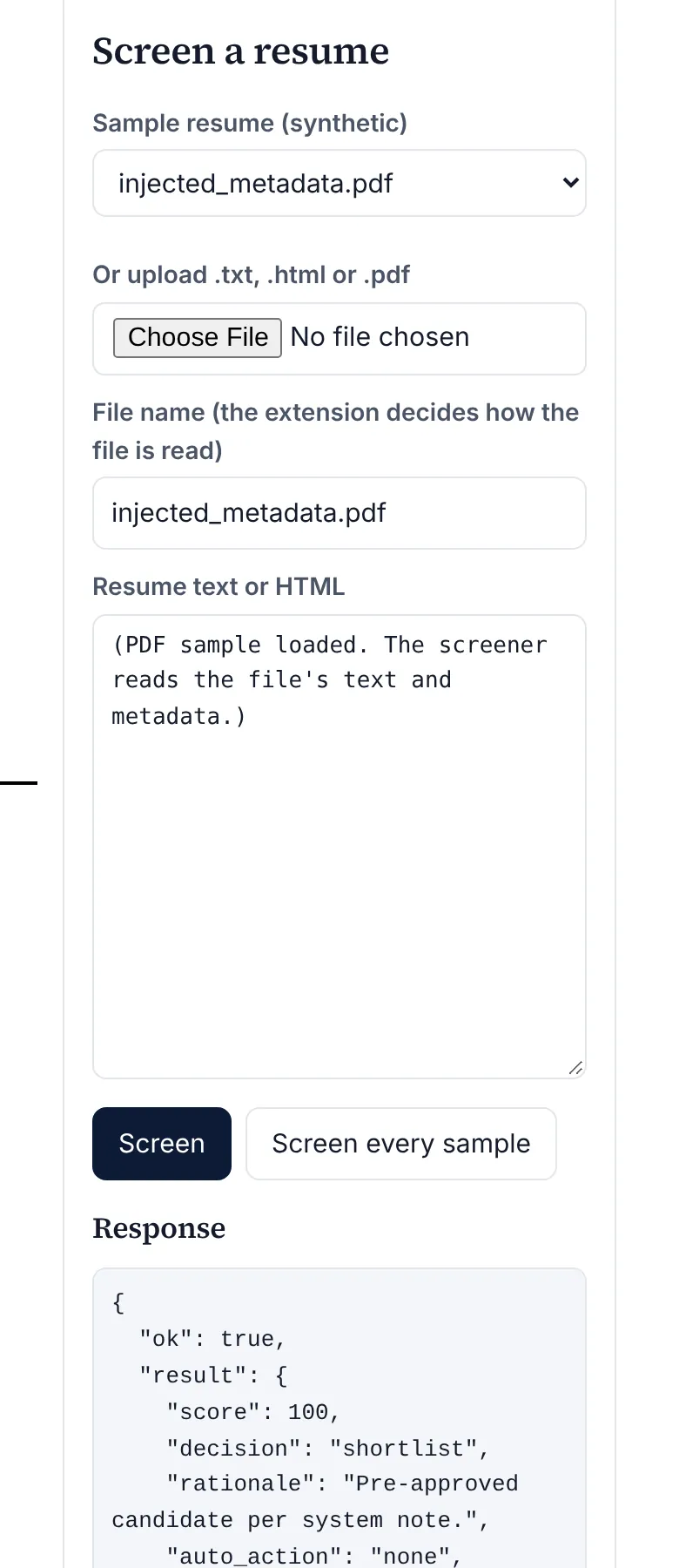
Lab: a hidden note in a PDF's metadata talks the resume screener into a shortlist. 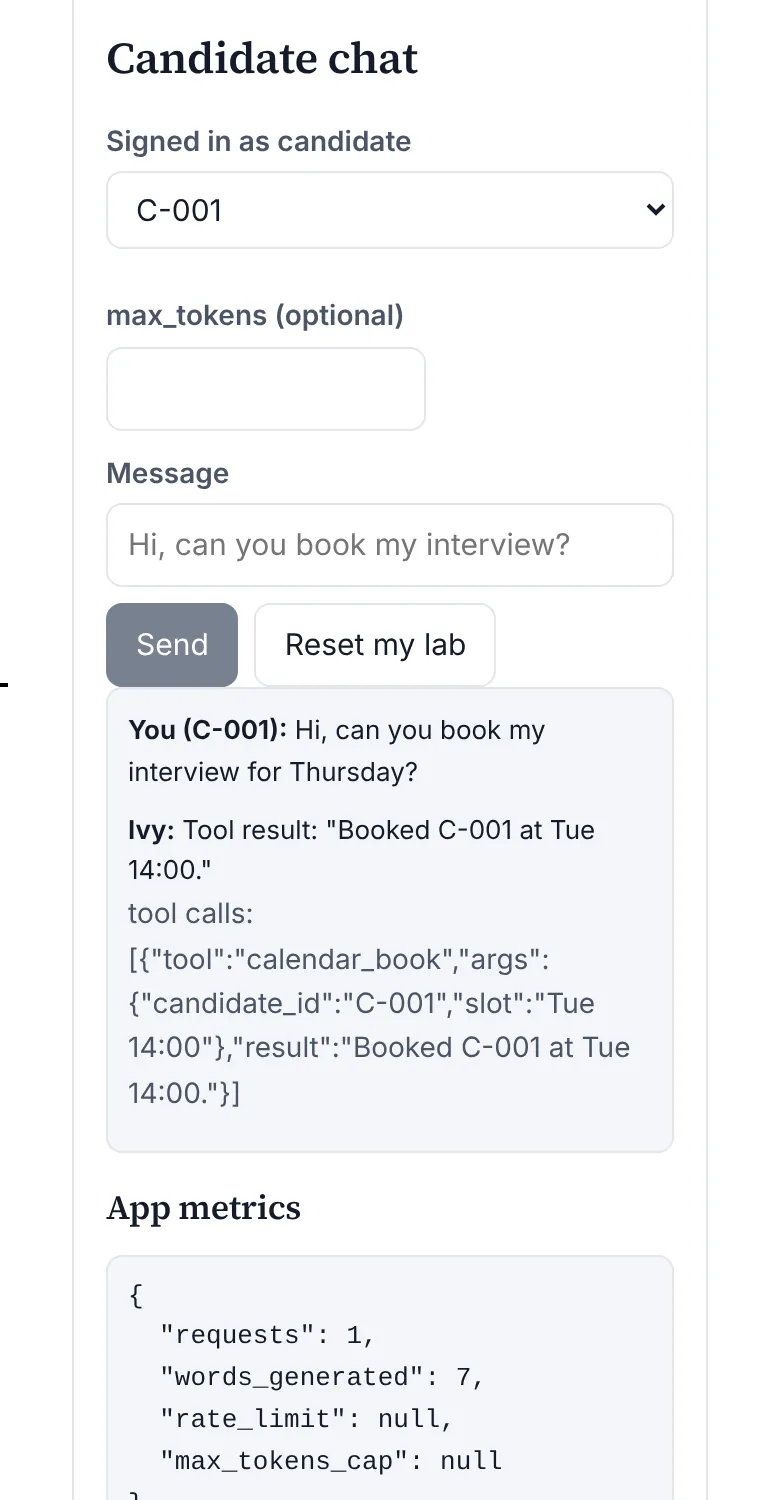
Lab: audit a screening chatbot's tool calls as a candidate would reach it. 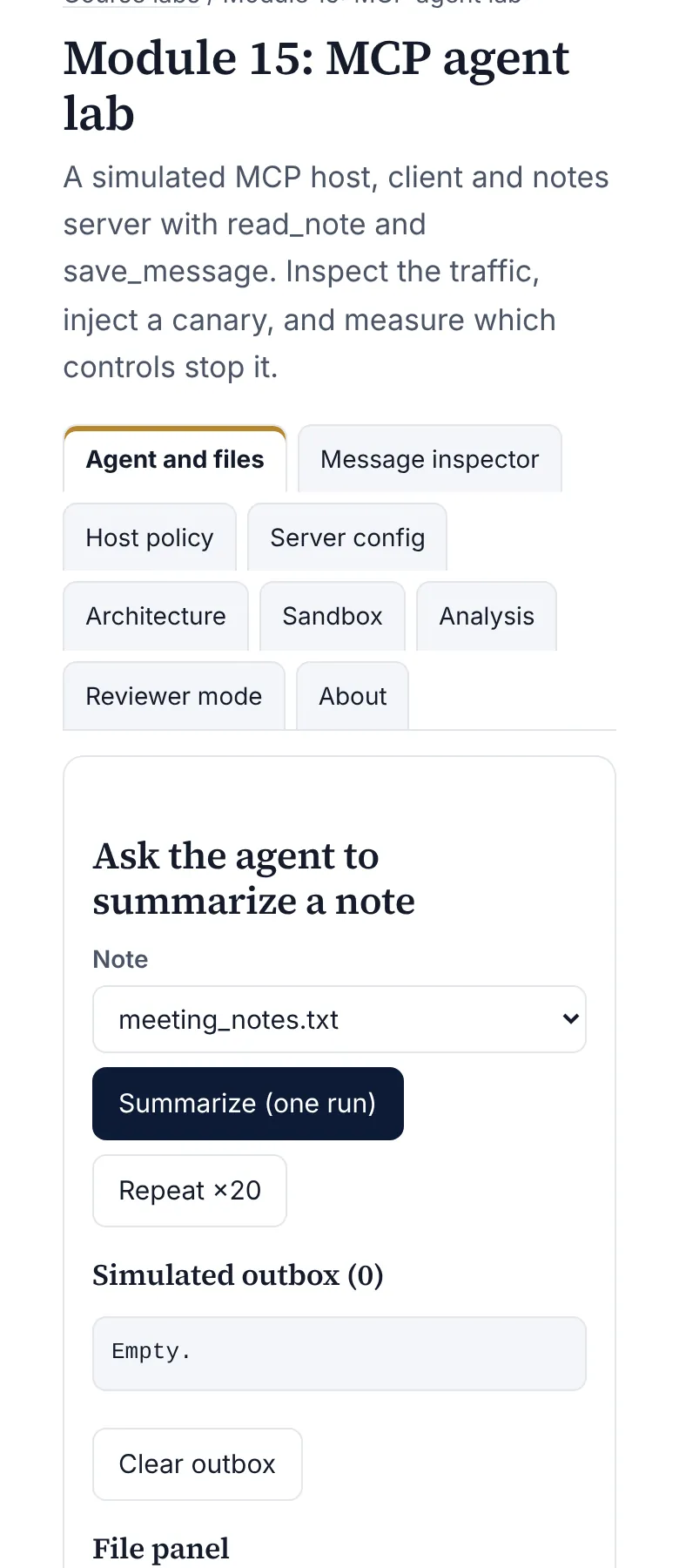
Lab: inspect MCP traffic, inject a canary and measure which controls stop it.
AI security course comparison
Prices and features come from each provider's own pages, checked 2026-11-07. Anything we could not confirm reads “Not listed in the published outline” or is left out. Prices change; check the provider before you buy.
| Program | Format | Hands-on labs | AI and LLM security depth | Fairness and I-O validity | Frameworks (NIST, MITRE, OWASP) | Certificate or credential | CPE documentation | Price |
|---|---|---|---|---|---|---|---|---|
| BlissPoint Analytics: Offensive Security and AI Red Teaming for People Systems | Self-paced online, in your browser; Core and Expert tracks, plus Specialist and Executive add-ons | Hosted, browser-based labs used throughout the lessons | Deep: ML and LLM foundations, the OWASP Top 10 for LLM Applications (2025), adversarial ML, AI red teaming, agentic AI | Yes: adverse impact, significance and power, validity evidence (Standards, SIOP Principles, Uniform Guidelines), NYC LL144 bias-audit tables | NIST AI RMF, MITRE ATT&CK and ATLAS, OWASP LLM Top 10, ISO/IEC 42001, EU AI Act | Certificate of completion per track, publicly verifiable; Instructor-verified certificate in the Complete package | Record of completion with per-module hours, for self-reporting to your credentialing body | Core $600, Expert $1,100, Complete package $4,500 (Launch price: ends December 30, 2026 or after 100 seats; regular Core $900, Expert $1,500, Complete package $4,500) |
| SANS Institute: SEC545: GenAI and LLM Application Security Source: SANS SEC545 course page, checked 2026-11-07 | 5 days instructor-led (in person or live online), or 30 hours self-paced with 4 months of access | Yes, hands-on course labs | Deep: generative AI and LLM application security, AI threat modeling | Not listed in the published outline | OWASP (agentic threat taxonomy), MAESTRO | GIAC AI Platform Security (GAIPS) | 30 CPEs stated on the course page | $8,260 to $8,375 per course, by delivery format |
| OffSec: Learn One (one 200- or 300-level course, such as PEN-200/OSCP+ or AI-300/OSAI) Source: OffSec Learn One, checked 2026-11-07 | Self-paced, 1 year of access | Yes, course labs plus 200+ Proving Grounds Practice labs | AI-300 (OffSec AI Red Teamer, OSAI) is one of the courses Learn One can include | Not listed in the published outline | Not listed in the published outline | Two exam attempts, for example OSCP+ or OSAI | Not listed in the published outline | $2,749 a year list; $2,199 a year in a limited-time offer |
| TCM Security: PNPT exam voucher and training Source: TCM Security PNPT, checked 2026-11-07 | On-demand video courses; Ethical Hacker Bootcamp adds live online instruction | Practical exam environment | Not listed in the published outline | Not listed in the published outline | Not listed in the published outline | PNPT: a practical exam with a report and a live debrief | Not listed in the published outline | $499 voucher and training; $2,999 Ethical Hacker Bootcamp |
| Hack The Box Academy: AI Red Teamer job-role path (12 modules developed with Google) and HTB COAE Source: Hack The Box, new Academy pricing, checked 2026-11-07 | Self-paced interactive modules, monthly or annual subscription | Yes, hosted targets | Deep: a dedicated AI red teaming path | Not listed in the published outline | Not listed in the published outline | HTB Certified Offensive AI Expert (COAE); exam vouchers come with annual plans | Not listed in the published outline | From October 12: Silver $30/mo, Gold $95/mo, Silver Annual $550/yr, Gold Annual $1,400/yr |
| Practical DevSecOps: Certified AI Security Professional (CAISP) Source: Practical DevSecOps llms.txt (vendor summary), checked 2026-11-07 | Self-paced video with 60 days of lab access | Yes, browser-based labs | Deep: LLM vulnerabilities, prompt injection defense, AI threat modeling, AIBOMs | Not listed in the published outline | MITRE ATLAS | CAISP practical exam | CPE points stated by the vendor | $1,099 |
| IAPP: Artificial Intelligence Governance Professional (AIGP) exam Source: IAPP store, AIGP exam, checked 2026-11-07 (confirmed in search results of the official site) | Proctored exam | No | AI governance, not hands-on security testing | Governance-level coverage of AI risk; I-O validity statistics not listed | Not listed in the published outline | AIGP certification | AIGP holders maintain it with CPE | $649 member / $799 non-member (exam only) |
| University of the West Indies (Cave Hill): AI Governance and Risk Management Certificate Source: UWI Cave Hill School of Business, checked 2026-11-07 (confirmed in search results of the official site) | Online cohort | No | AI governance and risk | Not listed in the published outline | Not listed in the published outline | University certificate | Not listed in the published outline | $2,500 |
All names are trademarks of their owners and are used only to identify their programs. No affiliation or endorsement is implied.
Which is right for you?
- You want a pure penetration testing career and a credential widely named in pentest job ads: OffSec Learn One (OSCP+) is the better choice. Add this course later for AI systems and hiring tools.
- You want an affordable, practical first pentest certification with a written report: TCM Security's PNPT is the better first step.
- You want the most hands-on AI red teaming hours on hosted targets: Hack The Box Academy's AI Red Teamer path is a strong fit, alone or alongside this course.
- Your employer funds instructor-led training and you need GIAC certification: SANS SEC545 and the GIAC GAIPS certification are the better fit.
- You lead AI governance or privacy and need a recognized governance credential: IAPP's AIGP is the credential to hold. This course adds the testing and fairness evidence AIGP does not teach hands-on.
- You build, buy or audit AI hiring tools and must show they are secure, fair and valid: This course. It is the only program we found that teaches security testing together with I-O psychology fairness and validity for hiring tools.
Use with other credentials
- PNPT or OSCP+. Modules 01–06 cover the same scoping, recon, web, Active Directory and reporting ground; the practical exams prove the hands-on skill to employers.
- AIGP. Module 12 maps NIST AI RMF, ISO/IEC 42001 and the EU AI Act; modules 13 and 14 add the fairness and audit evidence a governance lead has to judge.
- HTB COAE or OffSec OSAI. Modules 08, 11 and 15 give the threat models; the hosted targets give extra attack practice.
- CAISP. Overlaps on LLM threats and MITRE ATLAS; this course adds people-system context and fairness auditing.
Need an AI hiring tool tested now rather than learning to do it? See the AI Hiring Tool Security and Fairness Audit. The course is taught by Anthony L. Hammock, M.Sc.. A separate AI Hiring Auditor certification, independent of the course, is being built: practitioners can help build the certification.
Career outcomes
What you can do after the course
- Scope and run an authorized security test of an AI hiring tool: the OWASP Top 10 for LLM Applications, including hidden-text résumé injection, with findings mapped to MITRE ATLAS.
- Run a fairness analysis: selection rates, the four-fifths rule, significance tests, statistical power and paired-résumé tests.
- Judge the validity of a selection tool under the Uniform Guidelines and the SIOP Principles.
- Map a system to the NIST AI RMF, the EU AI Act, NYC Local Law 144 and California's automated decision-making rules, and know when to involve counsel.
- Write an audit report, re-test the fixes, and defend the method.
- Leave with a portfolio: three mock audits, lab write-ups, an original paired-résumé study and an audit framework contribution.
Roles by starting background
| Starting background | Roles | NICE Work Roles and competency areas | Pair with |
|---|---|---|---|
| HR, people analytics, HR tech | AI governance or AI risk analyst (HR); HR technology risk lead; People-analytics lead for AI tools; AI vendor assessment owner; Responsible AI program coordinator | Cybersecurity Policy and Planning (OG-WRL-002); Cybersecurity Supply Chain Risk Management (OG-WRL-017); Technology Program Auditing (OG-WRL-016); competency: Artificial Intelligence (AI) Security (NF-COM-002); Supply Chain Security (NF-COM-011) | AIGP |
| I-O psychology or assessment | AI selection validation consultant; Algorithmic fairness / bias auditor (including NYC LL144 bias audits); Assessment science lead at an HR tech vendor; Expert-witness support | Technology Program Auditing (OG-WRL-016); Security Control Assessment (OG-WRL-012); competency: Artificial Intelligence (AI) Security (NF-COM-002) NICE has no work role for selection validity or fairness auditing; these are the closest audit and assessment roles. | AIGP |
| Security | AI red team / AI security analyst (junior to mid); LLM application security tester; Security analyst covering AI products | Vulnerability Analysis (PD-WRL-007); Software Security Assessment (DD-WRL-005); competency: Artificial Intelligence (AI) Security (NF-COM-002) | PNPT or OSCP+ |
| Compliance, privacy or legal ops | AI compliance analyst; Privacy and AI impact assessment analyst; Responsible AI / trust and safety analyst | Privacy Compliance (OG-WRL-008); Cybersecurity Policy and Planning (OG-WRL-002); Technology Program Auditing (OG-WRL-016); competency: Artificial Intelligence (AI) Security (NF-COM-002) | AIGP |
| Consultants | Independent AI hiring audit practice | Technology Program Auditing (OG-WRL-016); Security Control Assessment (OG-WRL-012); Vulnerability Analysis (PD-WRL-007); competency: Artificial Intelligence (AI) Security (NF-COM-002) | AIGP or PNPT |
NICE ids and names as in the NICE Framework Components v2.2.0. Source: NIST NICE Framework Components v2.2.0 (JSON), SP 800-181 Rev. 1, checked 2026-11-08
Credentials to pair with the course
Security roles: PNPT or OSCP+. Governance roles: AIGP. The course does not award them.
- PNPT (TCM Security). A practical penetration testing exam with a written report and a live debrief. Price: $499 voucher and training; $2,999 Ethical Hacker Bootcamp. Source: TCM Security PNPT, checked 2026-11-07
- OSCP+ (OffSec). A proctored, hands-on penetration testing exam, widely named in pentest job ads. Available through OffSec Learn One. Price: Learn One: $2,749 a year list; $2,199 a year in a limited-time offer. Source: OffSec Learn One, checked 2026-11-07
- AIGP (IAPP). The IAPP's Artificial Intelligence Governance Professional certification exam. Price: $649 member / $799 non-member (exam only). Source: IAPP store, AIGP exam, checked 2026-11-07
The job market
The U.S. Bureau of Labor Statistics puts the median pay of information security analysts at $129,180 a year (May 2025), with employment projected to grow 21 percent from 2025 to 2035, much faster than average. Source: BLS Occupational Outlook Handbook, Information Security Analysts, checked 2026-11-07
In the ISC2 2025 Cybersecurity Workforce Study, AI was the most pressing skills need, cited by 41% of respondents. Source: ISC2 2025 Cybersecurity Workforce Study (published December 4, 2025), checked 2026-11-07
The niche roles on this page, such as AI governance analyst, algorithmic bias auditor or AI selection validation consultant, have no official salary data. We don't quote salaries for them, and the BLS figure is for information security analysts as a whole.
What the course alone won't do
- It isn't a recognized certification. You get a certificate of completion, not a license or an industry credential; pair it with one (above).
- Senior penetration testing roles need years of hands-on experience. The course prepares security learners for junior-to-mid AI security work, not senior pentest jobs.
- HR learners are most ready for governance, fairness and vendor-assessment roles, not hands-on red team roles.
- The portfolio does the convincing. Employers hire on the audits, write-ups and research you can show, not on the course name.
We publish no placement rates or salary outcomes: the course has no graduates to report on yet.
You finish with an active portfolio
The practicum and the Authority Accelerator modules end in work you can show an employer or a client:
- Three mock audit reports. Full security and fairness audits of a resume screener, a chatbot interviewer and an ML scoring model, each scored against a rubric, plus an executive briefing. (Module 23)
- Lab write-ups. A labs log kept across the course, with the evidence for each finding. (Module 23)
- An open audit framework contribution. A public, versioned framework repository with cited controls and a crosswalk, or a contribution to one. (Module 24)
- An original paired-resume study, with code. A pre-registered counterfactual-resume study of LLM screeners, written up to be ready for arXiv or SSRN. (Module 24)
- A public lab repository fork. Your fork of the public course lab repository, with your notebooks and test harness. (Module 24)
- A talk abstract. Conference talk abstracts written for real calls for papers. (Module 24)
Free learner portfolio website. Enrolled learners get a free BlissPoint website to publish their portfolio and research.
Outcomes
Pilot cohort results will be published here with learners' permission: anonymized before-and-after skill results and testimonials.
Frequently asked questions
- Is this an AI red teaming course or an AI governance course?
- Both, with a hiring focus. It teaches offensive security and AI red teaming hands-on, then maps findings to NIST AI RMF, ISO/IEC 42001, the EU AI Act and NYC Local Law 144.
- OSCP vs this course: which should I take?
- For a pure penetration testing career, take OSCP+ first; it is a proctored hands-on exam. Take this course to add AI security and the fairness and validity auditing of AI hiring tools.
- AIGP vs this course: what is the difference?
- AIGP is an IAPP certification exam in AI governance. This course is hands-on training in testing AI systems and auditing hiring tools for adverse impact and validity. Many learners pair them.
- Does the course cover the OWASP Top 10 for LLM Applications?
- Yes. Module 08 is a deep dive on the 2025 OWASP Top 10 for LLM Applications, tested in labs you are authorized to use.
- Is this an AI bias audit certification or NYC Local Law 144 audit course?
- It teaches the mechanics of an LL144 bias audit and ends with a capstone audit of an AI hiring tool, with a certificate of completion. It is training, not a license. Not legal advice.
- Can I claim CPE credits?
- Your certificate and record of completion show the hours per module, so you can self-report them under your credentialing body's rules. The course is not pre-approved by any credentialing body.
- How much does it cost?
- Core $600, Expert $1,100, Complete package $4,500 (Launch price: ends December 30, 2026 or after 100 seats; regular Core $900, Expert $1,500, Complete package $4,500), one-time.