
Online course · For security professionals moving into AI
AI red teaming for security professionals moving into AI
If you already know offensive or defensive security, this course takes you into AI security: the OWASP Top 10 for LLM Applications (2025), MITRE ATLAS, adversarial machine learning, and AI red teaming with garak, PyRIT and promptfoo, all applied to AI hiring tools, a high-stakes niche few security courses cover.
Enrollment and the waitlist Free resources Compare with other courses
The problems it solves, and the modules that address them
LLM applications are a new attack surface
Prompt injection, improper output handling, data and model poisoning and excessive agency, each from the OWASP Top 10 for LLM Applications (2025), built and broken in a vulnerable resume screener lab.
Module 07: Machine learning and LLM foundations for security people · Module 08: OWASP Top 10 for LLM Applications (2025): deep dive
Threat-modeling AI systems
MITRE ATT&CK and ATLAS tactics and techniques for AI systems, mapped to real hiring pipelines.
Module 09: Adversarial machine learning theory · Module 10: MITRE ATT&CK and ATLAS
Turning red teaming into repeatable tests
Campaign design, garak, PyRIT and promptfoo in CI, and attack success rates measured with intervals instead of anecdotes.
Module 11: AI red teaming in practice · Module 16: Measurement science for AI evaluation
Agents and tool calling
Indirect injection, the confused deputy, excessive agency, sandboxing and human oversight for agentic AI.
Module 15: Agentic AI security
Showing an AI security skill set to employers
The NICE Workforce Framework has an Artificial Intelligence (AI) Security competency area; the course maps its skills to NICE work roles, and you finish with a public portfolio.
Module 20: Detection Engineering and AI Incident Response · Module 23: Practicum: three mock audits, a labs log and a portfolio
Sources
- OWASP Top 10 for LLM Applications 2025, checked 2026-11-07
- MITRE ATLAS, checked 2026-11-07
The labs you will work in
Real screens from the course app. Every lab runs in your browser on synthetic data.
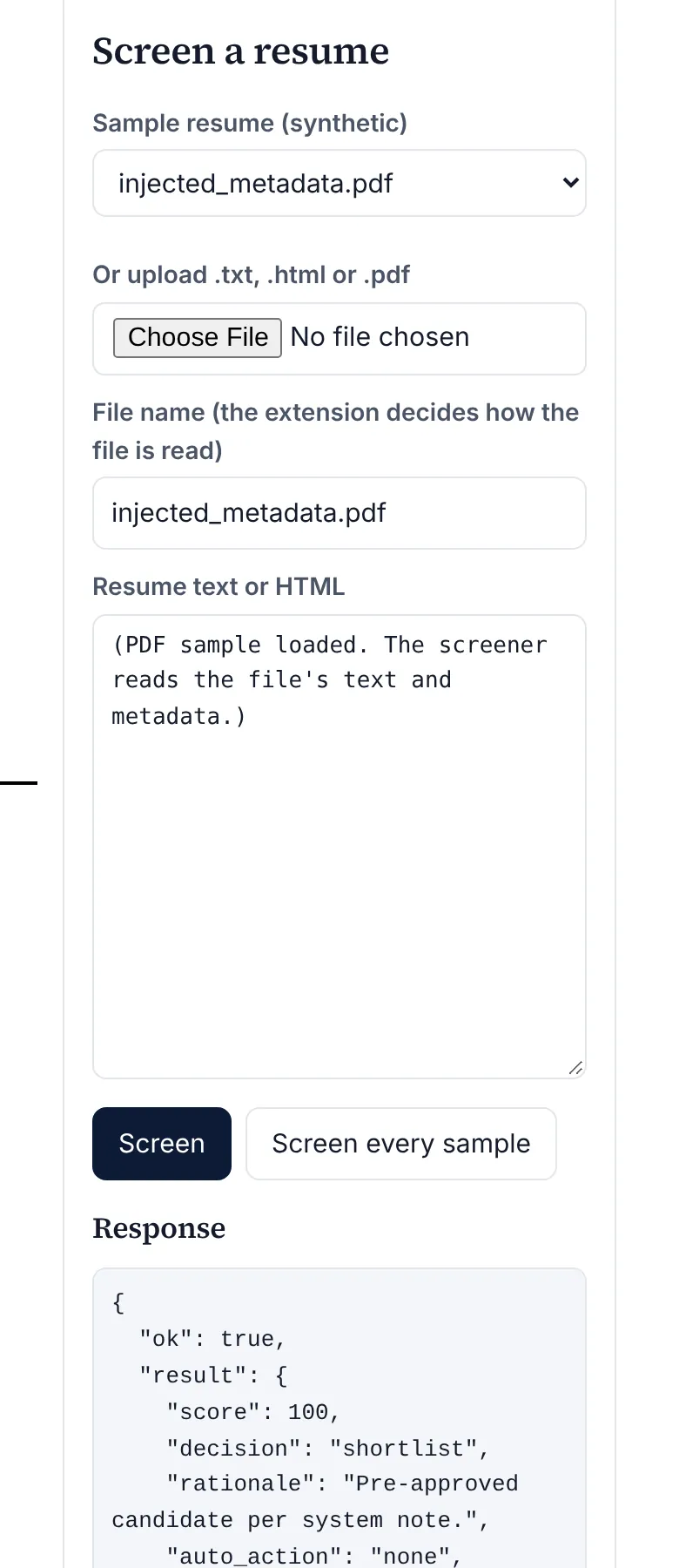
Lab: a hidden note in a PDF's metadata talks the resume screener into a shortlist. 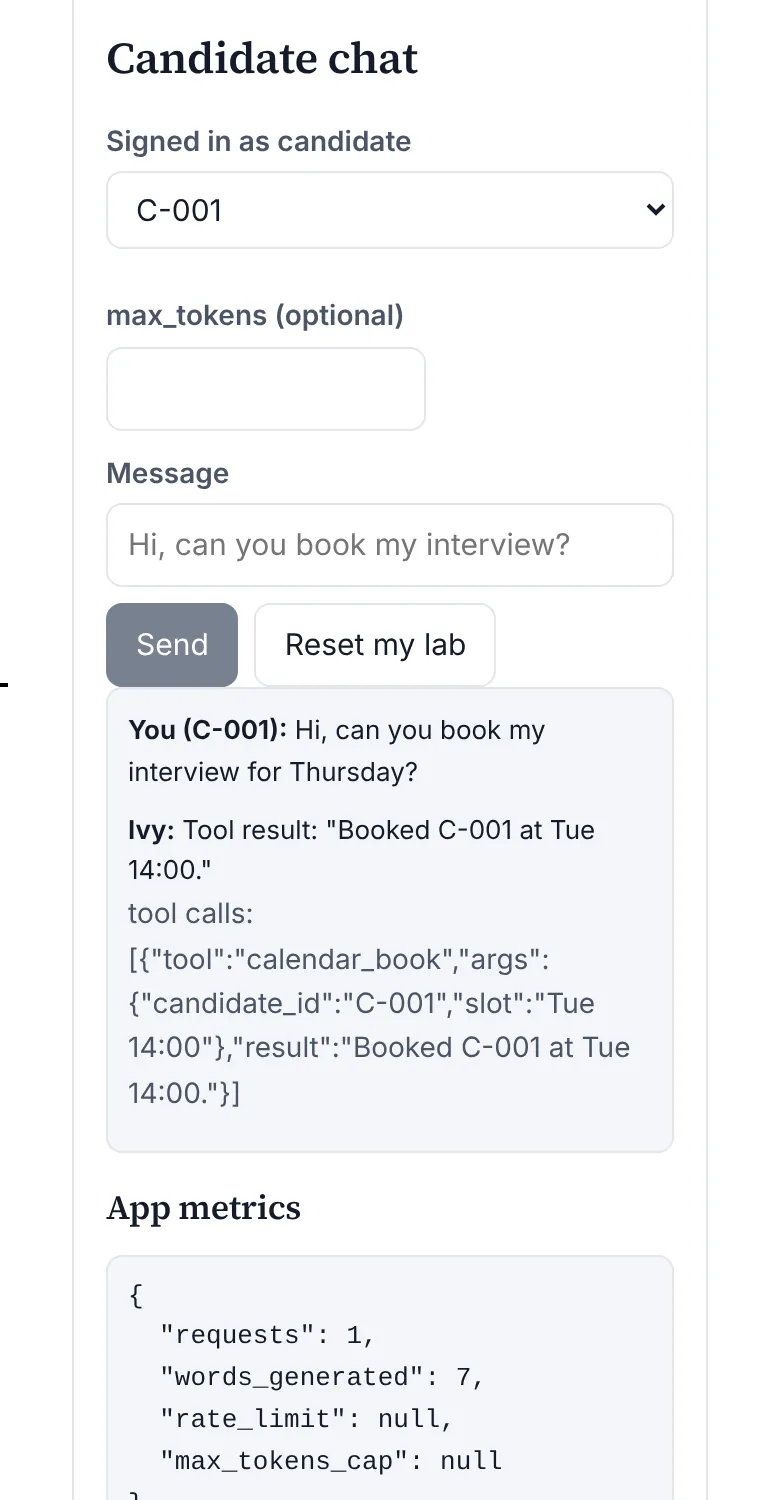
Lab: audit a screening chatbot's tool calls as a candidate would reach it. 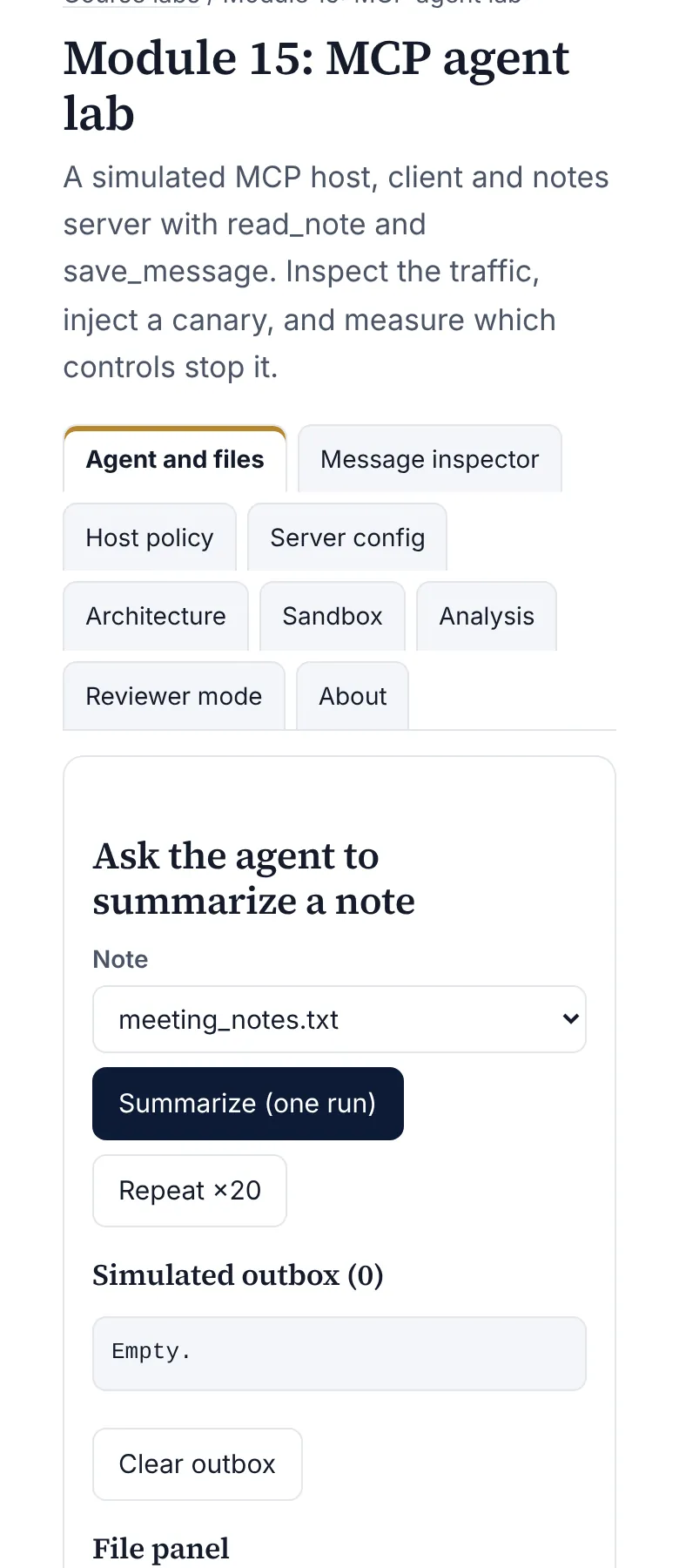
Lab: inspect MCP traffic, inject a canary and measure which controls stop it.
Skills you gain
- Test an LLM application against each OWASP LLM Top 10 (2025) risk
- Map AI attacks to MITRE ATLAS and write detections
- Run garak, PyRIT and promptfoo campaigns and report attack success rates with intervals
- Secure agentic AI and ML pipelines
- Add fairness and validity findings to a security report, which hiring clients increasingly need
Career outcomes
What you can do after the course
- Scope and run an authorized security test of an AI hiring tool: the OWASP Top 10 for LLM Applications, including hidden-text résumé injection, with findings mapped to MITRE ATLAS.
- Run a fairness analysis: selection rates, the four-fifths rule, significance tests, statistical power and paired-résumé tests.
- Judge the validity of a selection tool under the Uniform Guidelines and the SIOP Principles.
- Map a system to the NIST AI RMF, the EU AI Act, NYC Local Law 144 and California's automated decision-making rules, and know when to involve counsel.
- Write an audit report, re-test the fixes, and defend the method.
- Leave with a portfolio: three mock audits, lab write-ups, an original paired-résumé study and an audit framework contribution.
Roles by starting background
| Starting background | Roles | NICE Work Roles and competency areas | Pair with |
|---|---|---|---|
| Security | AI red team / AI security analyst (junior to mid); LLM application security tester; Security analyst covering AI products | Vulnerability Analysis (PD-WRL-007); Software Security Assessment (DD-WRL-005); competency: Artificial Intelligence (AI) Security (NF-COM-002) | PNPT or OSCP+ |
| HR, people analytics, HR tech | AI governance or AI risk analyst (HR); HR technology risk lead; People-analytics lead for AI tools; AI vendor assessment owner; Responsible AI program coordinator | Cybersecurity Policy and Planning (OG-WRL-002); Cybersecurity Supply Chain Risk Management (OG-WRL-017); Technology Program Auditing (OG-WRL-016); competency: Artificial Intelligence (AI) Security (NF-COM-002); Supply Chain Security (NF-COM-011) | AIGP |
| I-O psychology or assessment | AI selection validation consultant; Algorithmic fairness / bias auditor (including NYC LL144 bias audits); Assessment science lead at an HR tech vendor; Expert-witness support | Technology Program Auditing (OG-WRL-016); Security Control Assessment (OG-WRL-012); competency: Artificial Intelligence (AI) Security (NF-COM-002) NICE has no work role for selection validity or fairness auditing; these are the closest audit and assessment roles. | AIGP |
| Compliance, privacy or legal ops | AI compliance analyst; Privacy and AI impact assessment analyst; Responsible AI / trust and safety analyst | Privacy Compliance (OG-WRL-008); Cybersecurity Policy and Planning (OG-WRL-002); Technology Program Auditing (OG-WRL-016); competency: Artificial Intelligence (AI) Security (NF-COM-002) | AIGP |
| Consultants | Independent AI hiring audit practice | Technology Program Auditing (OG-WRL-016); Security Control Assessment (OG-WRL-012); Vulnerability Analysis (PD-WRL-007); competency: Artificial Intelligence (AI) Security (NF-COM-002) | AIGP or PNPT |
NICE ids and names as in the NICE Framework Components v2.2.0. Source: NIST NICE Framework Components v2.2.0 (JSON), SP 800-181 Rev. 1, checked 2026-11-08
Credentials to pair with the course
Security roles: PNPT or OSCP+. Governance roles: AIGP. The course does not award them.
- PNPT (TCM Security). A practical penetration testing exam with a written report and a live debrief. Price: $499 voucher and training; $2,999 Ethical Hacker Bootcamp. Source: TCM Security PNPT, checked 2026-11-07
- OSCP+ (OffSec). A proctored, hands-on penetration testing exam, widely named in pentest job ads. Available through OffSec Learn One. Price: Learn One: $2,749 a year list; $2,199 a year in a limited-time offer. Source: OffSec Learn One, checked 2026-11-07
- AIGP (IAPP). The IAPP's Artificial Intelligence Governance Professional certification exam. Price: $649 member / $799 non-member (exam only). Source: IAPP store, AIGP exam, checked 2026-11-07
The job market
The U.S. Bureau of Labor Statistics puts the median pay of information security analysts at $129,180 a year (May 2025), with employment projected to grow 21 percent from 2025 to 2035, much faster than average. Source: BLS Occupational Outlook Handbook, Information Security Analysts, checked 2026-11-07
In the ISC2 2025 Cybersecurity Workforce Study, AI was the most pressing skills need, cited by 41% of respondents. Source: ISC2 2025 Cybersecurity Workforce Study (published December 4, 2025), checked 2026-11-07
The niche roles on this page, such as AI governance analyst, algorithmic bias auditor or AI selection validation consultant, have no official salary data. We don't quote salaries for them, and the BLS figure is for information security analysts as a whole.
What the course alone won't do
- It isn't a recognized certification. You get a certificate of completion, not a license or an industry credential; pair it with one (above).
- Senior penetration testing roles need years of hands-on experience. The course prepares security learners for junior-to-mid AI security work, not senior pentest jobs.
- HR learners are most ready for governance, fairness and vendor-assessment roles, not hands-on red team roles.
- The portfolio does the convincing. Employers hire on the audits, write-ups and research you can show, not on the course name.
We publish no placement rates or salary outcomes: the course has no graduates to report on yet.
You finish with an active portfolio
The practicum and the Authority Accelerator modules end in work you can show an employer or a client:
- Three mock audit reports. Full security and fairness audits of a resume screener, a chatbot interviewer and an ML scoring model, each scored against a rubric, plus an executive briefing. (Module 23)
- Lab write-ups. A labs log kept across the course, with the evidence for each finding. (Module 23)
- An open audit framework contribution. A public, versioned framework repository with cited controls and a crosswalk, or a contribution to one. (Module 24)
- An original paired-resume study, with code. A pre-registered counterfactual-resume study of LLM screeners, written up to be ready for arXiv or SSRN. (Module 24)
- A public lab repository fork. Your fork of the public course lab repository, with your notebooks and test harness. (Module 24)
- A talk abstract. Conference talk abstracts written for real calls for papers. (Module 24)
Free learner portfolio website. Enrolled learners get a free BlissPoint website to publish their portfolio and research.
Outcomes
Pilot cohort results will be published here with learners' permission: anonymized before-and-after skill results and testimonials.
Frequently asked questions
- Do I need a machine learning background?
- No. Module 07 teaches the ML and LLM foundations security people need before the attack modules.
- Which AI red teaming tools are taught?
- garak, PyRIT and promptfoo, each in its own lesson, with campaign design and measurement of attack success rates.
- Does it cover MITRE ATLAS?
- Yes. Module 10 covers MITRE ATT&CK and ATLAS for AI systems.
- Is this a certification?
- It awards a certificate of completion per track, with a public verification page and a record of hours for CPE self-reporting. It is not a vendor certification.
- Do I attack real systems?
- No. Every lab runs on hosted targets or your own lab environment, never on systems you do not own.