
What does AI workforce readiness mean for a CHRO?
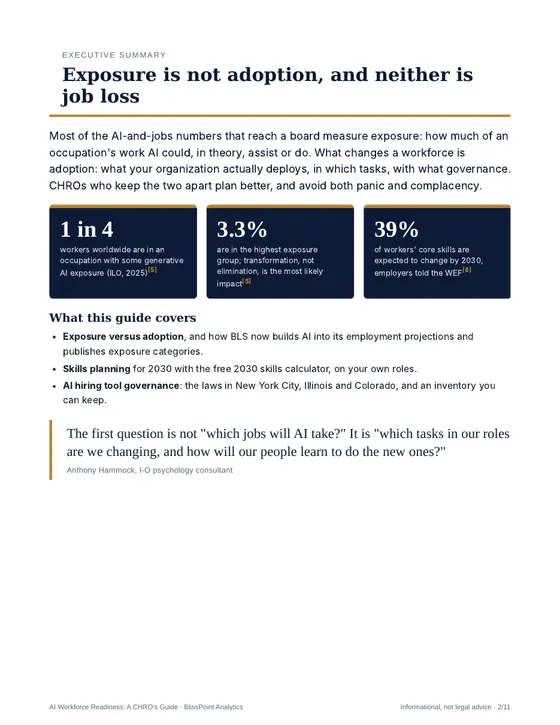
AI workforce readiness starts by separating exposure (what AI could do in your roles) from adoption (what you actually deploy), then planning skills role by role and governing the AI tools already in hiring. The ILO finds about one in four workers worldwide in an exposed occupation but only 3.3% in the most exposed group, and judges transformation of jobs the most likely impact.
This free guide brings together BLS's AI projections work and exposure categories, the ILO's 2025 index and the WEF's 2025 skills outlook, with a readiness assessment, a 90-day start and the AI hiring laws in New York City, Illinois and Colorado.
What the exposure research says
The ILO's refined global index, published in May 2025, finds about one in four workers worldwide in an occupation with some generative AI exposure and 3.3% in the highest group. Exposure is 34% of employment in high-income countries against 11% in low-income ones; clerical work remains the most exposed; and the authors judge transformation of jobs the most likely impact.
BLS publishes exposure categories for the 831 detailed occupations in its projections, from low to very high. They combine theoretical and observed exposure, and BLS is explicit that a category is not a forecast of employment growth or decline.
How BLS builds AI into its projections
In its 2024–34 projections, BLS expects AI and IT adoption to support growth in data scientists (+33.5%), information security analysts (+28.5%) and software developers (+15.8%), and to contribute to declines for customer service representatives (−5.5%), procurement clerks (−8.7%) and legal secretaries (−5.8%).
A four-part readiness assessment
Task exposure: which of your roles have the most information processing, writing and routine analysis, and which are hands-on, caring or in-person? Actual adoption: which tools are in use today, by whom, approved or not? Skills: which skills do your roles depend on, and which are expected to grow? Governance: where does AI touch decisions about people, and what notices, audits and human review apply where you hire?
Plan on roles, not headlines. A company of customer service representatives and one of registered nurses face very different exposure. Redesign before you reduce: reskilling the people who know the work is usually cheaper than replacing them, and keeps the knowledge you need to use AI well.
Skills planning for 2030
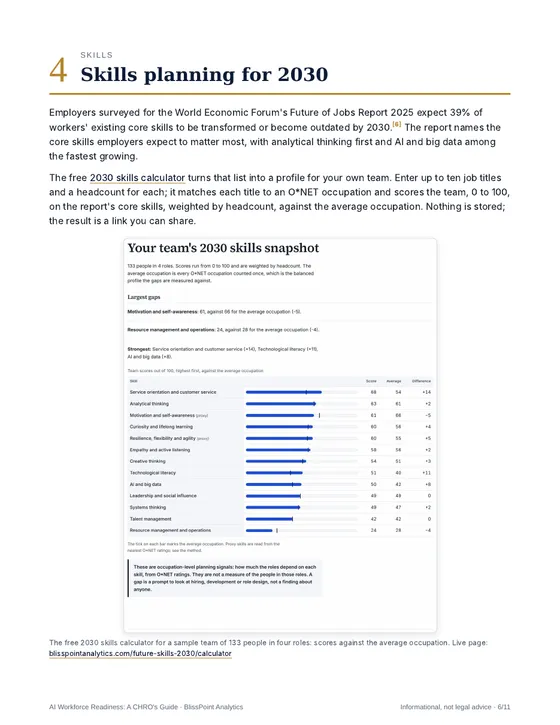
Employers surveyed for the World Economic Forum's Future of Jobs Report 2025 expect 39% of workers' core skills to be transformed or outdated by 2030. The free 2030 skills calculator turns that into a profile of your own team: enter up to ten job titles with headcounts and it scores the team on the report's core skills from O*NET data, against the average occupation.
In the paper's sample team of 133 people in four roles, the largest gaps against the average occupation were motivation and self-awareness, and resource management and operations; the strongest were service orientation, technological literacy, and AI and big data. These are occupation-level signals from O*NET ratings, not a measure of the people in the roles. Gaps are prompts to look at hiring, development and role design.
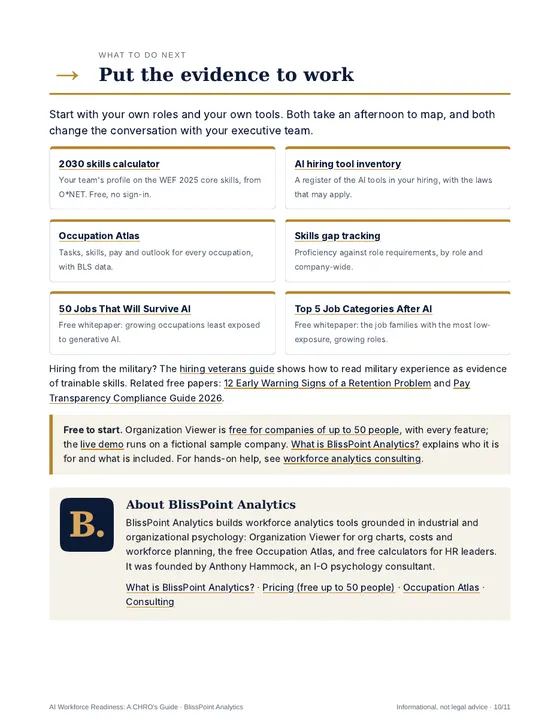
A 90-day start: run the calculator on your ten largest roles and inventory AI tools in month one; map changing tasks with managers in two pilot roles in month two; train, measure and report to the executive team on adoption, not exposure, in month three.
AI in hiring: the laws to know
New York City Local Law 144 requires a bias audit within the past year, a public summary and candidate notices for automated employment decision tools. The Illinois Artificial Intelligence Video Interview Act requires notice and consent, and HB 3773 makes discriminatory AI use a civil rights violation from January 1, 2026. Colorado's SB 26-189 applies from 2027. Keep a register in the AI hiring tool inventory and ask five questions of every tool. This is general information, not legal advice; confirm with counsel.
For career-level views, see 50 Jobs That Will Survive the AI Takeover and Top 5 Job Categories After AI.
Informational, not legal advice. Forecasts are uncertain; exposure is not job loss.
Frequently asked questions
What is the difference between AI exposure and AI adoption?
Exposure describes how much of an occupation's work AI could assist or do. Adoption is what an organization actually deploys. BLS's exposure categories combine theoretical exposure with observed use, and are not forecasts of job growth or decline.
Which laws cover AI in hiring?
Among others, New York City Local Law 144 (bias audits and notices for automated employment decision tools), the Illinois Artificial Intelligence Video Interview Act and HB 3773, and Colorado's SB 26-189 from 2027. Not legal advice; confirm with counsel.
How do we plan skills for 2030?
Start from your own role mix. The free 2030 skills calculator scores up to ten roles on the World Economic Forum's 2025 core skills from O*NET data, against the average occupation.
Is any job AI-proof?
No. Exposure scores describe today's work, forecasts are uncertain, and BLS states that a low exposure category does not mean an occupation is safe from future change.
What does a 90-day start look like?
Days 1 to 30: run the 2030 skills calculator on your ten largest roles, inventory the AI tools in use and pick two pilot roles. Days 31 to 60: map which tasks change with the pilot managers and agree training. Days 61 to 90: train, measure quality and workload, and report to the executive team on adoption, not exposure.
Sources
- U.S. Bureau of Labor Statistics: Incorporating AI impacts in BLS employment projections (Monthly Labor Review, February 2025)
- U.S. Bureau of Labor Statistics: Artificial intelligence, information technology, and employment, 2024–34 (July 2026)
- U.S. Bureau of Labor Statistics: AI exposure categories
- ILO Working Paper 140: Generative AI and jobs, a refined global index of occupational exposure (2025)
- World Economic Forum: The Future of Jobs Report 2025