


Which states require pay ranges in job postings in 2026?
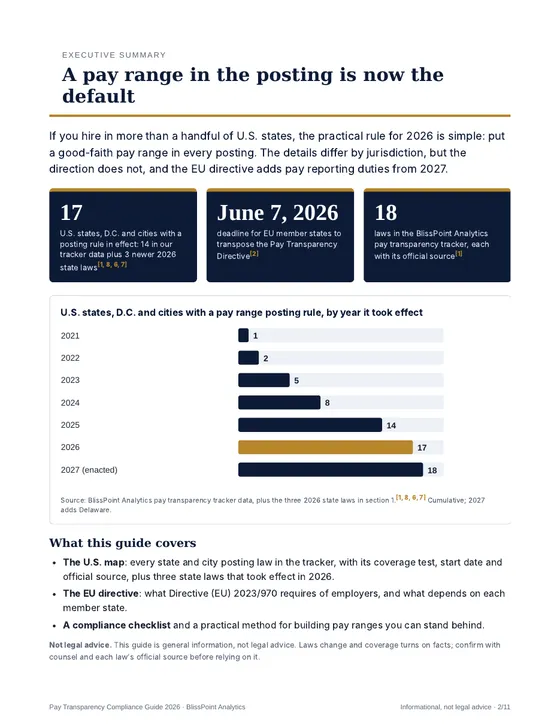
In 2026, a pay range in the job posting is the practical default for U.S. employers hiring across states: 14 U.S. jurisdictions in our tracker data had a posting rule in effect, and Connecticut, Maine and Virginia added theirs during 2026. EU member states were due to transpose the Pay Transparency Directive by June 7, 2026. This free guide maps the laws and shows how to build ranges you can defend.
It is general information, not legal advice. Every law in it links to its official source, with the date it was last checked.
If you hire in more than a handful of U.S. states, the practical rule for 2026 is to put a good-faith pay range in every posting. In the BlissPoint Analytics tracker data, Colorado, California, Washington, New York State and New York City, Illinois, Maryland, Massachusetts, Hawaii, the District of Columbia, Minnesota, Vermont, New Jersey and Cleveland have posting rules in effect, with Delaware from 2027. Connecticut, Maine and Virginia added theirs during 2026.
Coverage tests differ: Maryland has no minimum employer size, New York needs four or more employees, Illinois and Washington 15, Massachusetts 25, Minnesota 30 and Hawaii 50. The pay transparency tracker links every law to its official source with the date it was last checked. This is general information, not legal advice.
Remote and multi-state roles
Most posting laws follow the job, not the office. Colorado and Washington cover remote jobs that could be filled by a resident; Illinois covers work reporting to an Illinois office or supervisor; New York City covers work performed at least partly in the city. A remote role advertised nationally is therefore covered by the strictest place it could be filled.
The practical defaults: a range in every external and internal posting, the narrowest range you can defend in good faith (several laws bar open-ended ranges such as "$60,000 and up"), a general benefits description where the law asks, and promotion notices to current employees where required.
The EU Pay Transparency Directive
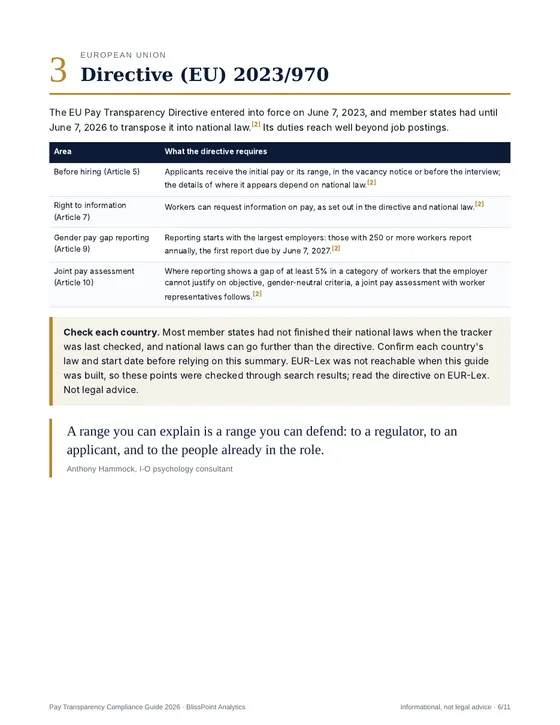
Directive (EU) 2023/970 entered into force on June 7, 2023, and member states had until June 7, 2026 to transpose it. Applicants receive the initial pay or its range before the interview; workers can request pay information; employers with 250 or more workers report their gender pay gap annually, the first report due by June 7, 2027; and an unjustified gap of at least 5% in a category of workers leads to a joint pay assessment. National laws can go further, so confirm each country.
How to build pay ranges you can defend
A posted range is a promise about what the organization expects to pay. It is defensible only if it comes from a structure that treats similar work the same way.
Five steps
Group the work into families and levels with a job architecture. Price each level against market data; BLS medians in the Occupation Atlas are a free starting point. Set a spread that fits how much the role grows. Place current people and fix anyone below the minimum. Record the date and data behind each range and confirm it at least once a year.
The retention side
Once ranges are public, people paid below a posted range for their own role will notice. The pay range review lists them; fix those cases before the posting goes live. The companion paper, 12 Early Warning Signs of a Retention Problem, treats pay below range as one of its indicators.
A compliance checklist
Map your exposure: every location you hire in, including where remote hires live, your headcount against each law's threshold, and the EU countries where you employ anyone. Fix the postings, including third-party and agency ones, and keep copies. Brief recruiters and managers on discussing the range, check current pay against what you publish, and stop asking about pay history where it is banned. The checklist is a planning aid; confirm with counsel and each law's official source.
General information, not legal advice. Laws change and coverage turns on facts; confirm with counsel and each law's official source.
Frequently asked questions
Which U.S. states require pay ranges in job postings?
In our tracker data: Colorado, California, Washington, New York State and New York City, Illinois, Maryland, Massachusetts, Hawaii, the District of Columbia, Minnesota, Vermont, New Jersey and Cleveland, with Delaware from 2027. Connecticut, Maine and Virginia added laws in 2026. Coverage tests differ; check each official source.
Does a remote job need a pay range?
Often, yes. Several laws reach jobs that could be filled by someone in the state, or that report to an office or supervisor there, wherever the employer is based.
When does the EU Pay Transparency Directive apply?
Member states were to transpose Directive (EU) 2023/970 by June 7, 2026. What employers must do, and from when, depends on each country's national law.
Is this legal advice?
No. It is general information to help plan job postings and pay ranges. Confirm with counsel and each law's official source.
How do you build a pay range you can defend?
Group roles into families and levels, price each level against market data, set a spread, place current people and fix anyone below the minimum, and record the data and date behind each range. General information, not legal advice.