
Pay transparency tracker for job postings
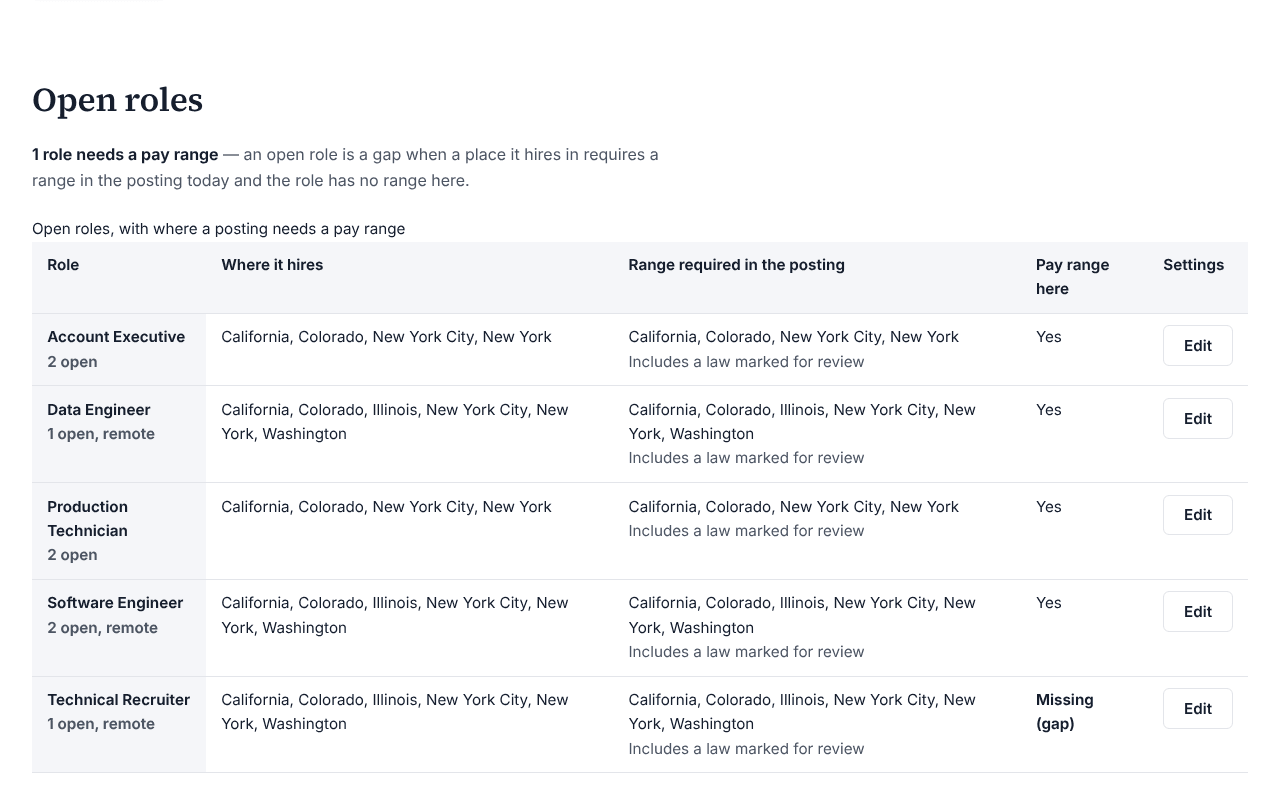
The pay transparency tracker is an Organization Viewer tool that checks each open role against the pay transparency laws where you hire and shows which job postings still need a pay range.
Pay transparency laws ask employers in a growing list of places to put a pay range in the job posting, or to give one when asked. The tracker in Organization Viewer lists the places you hire, checks each open role against the laws there, and shows which roles still need a pay range.
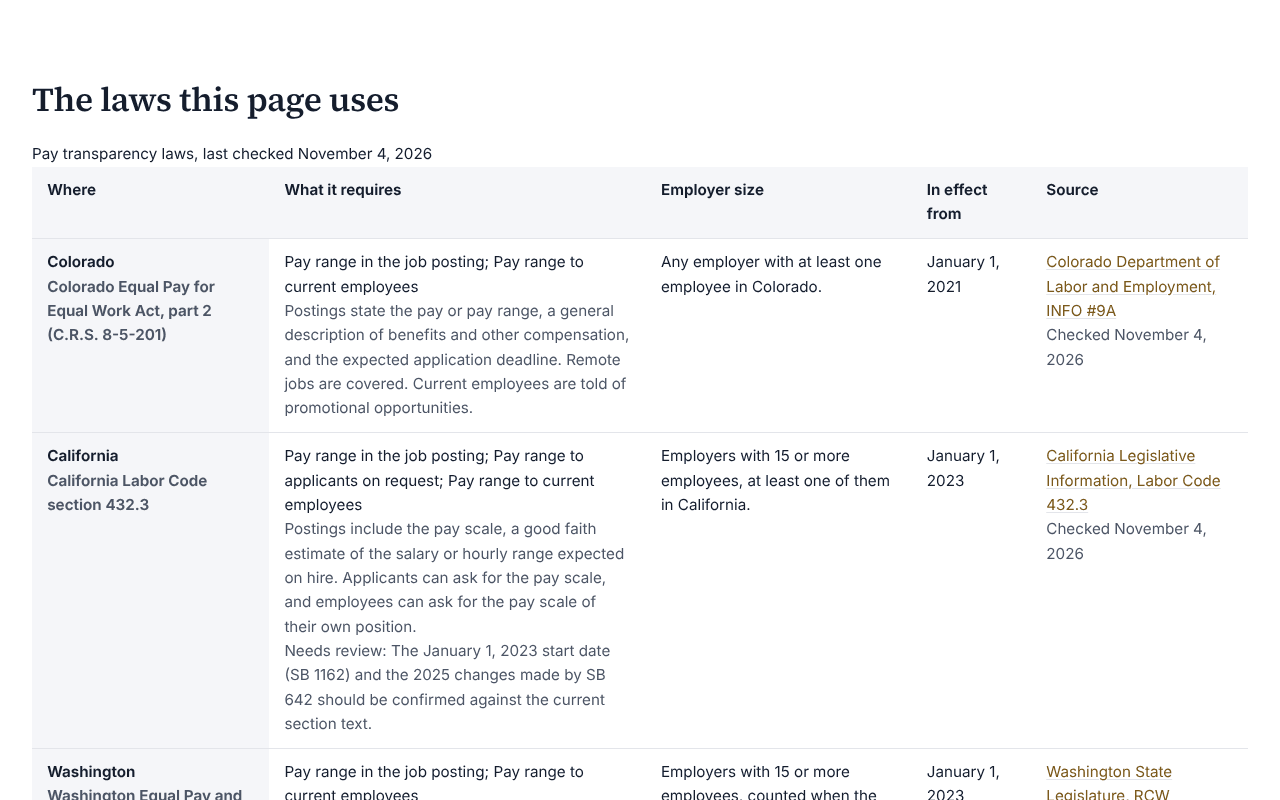
Every law it uses is listed on this page with what it requires, the employer size it applies from, its start date, a link to the official source and the date it was last checked. General information, not legal advice.
Who is this for?
- HR and talent teamsYou’ll use it to see which job postings need a pay range before they go live, in every place you hire.
- Compensation ownersYou’ll use it to find open roles with no pay range yet, without the page showing the ranges themselves.
- Companies hiring remotelyYou’ll use it to check remote roles against remote-only rules, kept separate from office locations.
What it does
- Checks each open role (a role whose planned headcount is more than the people in it on your live org chart) against the places you hire.
- Shows which of those places require a pay range in the posting today, and which have a law starting soon.
- Flags a gap: a role that needs a range in at least one place today and has no minimum and maximum set in Job architecture.
- Exports the gap list as CSV.
- Shows whether a role has a pay range, never the range itself.
What it costs: Included on every Organization Viewer plan, including Free for up to 50 people. Paid plans start at $300 a month for 51 to 250 people. See pricing.
How it works, step by step
- Open Pay transparency in your company. Under Where you hire, add each state, city or country you hire in, and check We only hire remote workers there for places with no office.
- For each open role, choose Edit to say whether it can be filled remotely and, if it doesn't hire everywhere you list, which locations it hires in. A role that isn't remote skips remote-only locations.
- Give roles their pay ranges in Job architecture.
- Read the gap list, and download it with Export gap list.
Feature details
How a law is matched to a place
- A city is covered by its own law and its state's: a New York City location is checked against both.
- Employer-size thresholds are compared with the number of people on your live org chart. Many laws count employees differently, so check each law's source.
- Laws with open questions are marked Needs review, with the reason, rather than guessed.
Who can do what
- Viewers can see the page.
- Editors and up can change locations and role settings.
- Whether a role has a range is shown, never the range itself.
Every pay transparency law the tracker uses
General information, not legal advice. Coverage tests such as how employees are counted, remote work and exemptions are summarized here, not reproduced. Check each law's official source before relying on it.
| Jurisdiction and law | What it requires | Employer size | Takes effect | Official source | Last checked |
|---|---|---|---|---|---|
| Colorado Colorado Equal Pay for Equal Work Act, part 2 (C.R.S. 8-5-201) | Pay range in the job posting; Pay range to current employees | Any employer with at least one employee in Colorado. | January 1, 2021 | Colorado Department of Labor and Employment, INFO #9A | November 4, 2026 |
| California California Labor Code section 432.3 Needs review: The January 1, 2023 start date (SB 1162) and the 2025 changes made by SB 642 should be confirmed against the current section text. | Pay range in the job posting; Pay range to applicants on request; Pay range to current employees | Employers with 15 or more employees, at least one of them in California. | January 1, 2023 | California Legislative Information, Labor Code 432.3 | November 4, 2026 |
| Washington Washington Equal Pay and Opportunities Act (RCW 49.58.110) | Pay range in the job posting; Pay range to current employees | Employers with 15 or more employees, counted when the job is posted, with at least one in Washington. | January 1, 2023 | Washington State Legislature, RCW 49.58.110 | November 4, 2026 |
| New York State New York Labor Law section 194-b Needs review: The September 17, 2023 effective date was not shown in the source checked; confirm it on the Department of Labor page or the statute. | Pay range in the job posting | Employers with four or more employees. | September 17, 2023 | New York State Department of Labor, Pay Transparency | November 4, 2026 |
| New York City New York City salary transparency law (as amended by Local Law 59 of 2022) | Pay range in the job posting | Employers with four or more employees (owners count), or one or more domestic workers; one employee in the city is enough. | November 1, 2022 | NYC Commission on Human Rights, salary transparency factsheet | November 4, 2026 |
| Illinois Illinois Equal Pay Act of 2003, pay transparency amendments (820 ILCS 112/10) | Pay range in the job posting; Pay range to current employees | Employers with 15 or more employees, inside or outside Illinois. | January 1, 2025 | Illinois Department of Labor, Equal Pay Act pay transparency FAQ | November 4, 2026 |
| Maryland Maryland wage range transparency (Labor and Employment 3-304.2) | Pay range in the job posting | Public and private employers, with no minimum size. | October 1, 2024 | Maryland Division of Labor and Industry, wage range transparency FAQ | November 4, 2026 |
| Massachusetts Massachusetts Wage Transparency Act | Pay range in the job posting; Pay range to applicants on request; Pay range to current employees | Employers with 25 or more employees whose primary place of work was Massachusetts in the prior calendar year. | October 29, 2025 | Massachusetts Attorney General, Pay Transparency in Massachusetts | November 4, 2026 |
| Hawaii Hawaii Act 203 (2023) Needs review: 2026 bills (HB 2367, SB 2386) would remove the 50-employee exemption; whether either was enacted was not confirmed. | Pay range in the job posting | Employers with 50 or more employees. | January 1, 2024 | Hawaii Civil Rights Commission, Act 203 pay transparency FAQs | November 4, 2026 |
| District of Columbia District of Columbia Wage Transparency Omnibus Amendment Act of 2023 (D.C. Code 32-1453.01) | Pay range in the job posting | Employers with employees in the District; no minimum size is stated. | June 30, 2024 | D.C. Code 32-1453.01, Council of the District of Columbia | November 4, 2026 |
| Minnesota Minnesota Statutes section 181.173 | Pay range in the job posting | Employers with 30 or more employees at one or more sites in Minnesota. | January 1, 2025 | Minnesota Revisor of Statutes, 181.173 | November 4, 2026 |
| Vermont Vermont Act 155 (2024), disclosure of compensation to prospective employees Needs review: The act codifies the rule at 21 V.S.A. 495o, while the current statutes site lists it as 495p; confirm the section number. | Pay range in the job posting | Employers with five or more employees. | July 1, 2025 | Vermont Attorney General, guidance on Act 155 | November 4, 2026 |
| New Jersey New Jersey pay transparency law Needs review: The department's rules were described as proposed; whether they have been adopted was not confirmed. | Pay range in the job posting; Pay range to current employees | Employers with 10 or more employees over 20 calendar weeks that do business, employ people or take applications in New Jersey. | June 1, 2025 | New Jersey Department of Labor and Workforce Development, pay transparency | November 4, 2026 |
| Delaware Delaware pay transparency law (House Substitute 2 for House Bill 105) Needs review: Not yet in effect; confirm the effective date and the enforcement provisions against the enacted text. | Pay range in the job posting | Employers with 26 or more employees (25 or fewer are exempt). | September 26, 2027 | Delaware General Assembly, House Bill 105 | November 4, 2026 |
| Cleveland, Ohio Cleveland Codified Ordinances chapter 669 Needs review: How remote and multi-state roles are treated was not stated in the source checked. | Pay range in the job posting | Private employers with 15 or more employees within the City of Cleveland. | October 27, 2025 | City of Cleveland Fair Employment Wage Board, laws and procedures | November 4, 2026 |
| Ontario Ontario Employment Standards Act, publicly advertised job postings | Pay range in the job posting | Employers with 25 or more employees in Ontario on the day the job is posted. Not required above $200,000 a year. | January 1, 2026 | Ontario, Your guide to the Employment Standards Act: publicly advertised job postings | November 4, 2026 |
| British Columbia British Columbia Pay Transparency Act | Pay range in the job posting | Employers with employees in B.C., except federally regulated employers. | November 1, 2023 | Province of British Columbia, wage or salary information on job postings | November 4, 2026 |
| European Union member states EU Pay Transparency Directive (EU) 2023/970, article 5 Needs review: Most member states had not finished their national laws when checked; confirm each country's law and its start date. | Pay range in the job posting; Pay range to applicants on request | Applies to employers of every size; each member state sets the details in its own law. | June 7, 2026 | EUR-Lex, Directive (EU) 2023/970 | November 4, 2026 |
For a full walk-through of the U.S. posting laws, the EU directive and how to build pay ranges, read the free pay transparency compliance guide 2026. Not legal advice.
Questions
Is this legal advice?
No. It is general information for planning job postings. Coverage tests such as how employees are counted, remote work and exemptions are summarized, not reproduced. Check each law's official source before relying on it.
How current is the list of laws?
Every entry shows the date it was last checked against its official source. 8 of the 18 entries are marked Needs review, each with the open question.
Does it show our pay ranges?
No. It shows whether a role has a minimum and maximum set, never the figures.
Which roles does it check?
Open roles: roles in Job architecture whose planned headcount is more than the people in them on your live org chart.
Learn more
Help articles
Related consulting
Related features
- AI hiring tool inventory
- Manager and 360 surveys
- Headcount budget planner
- Directory sync and chat alerts
- Attrition analytics
- Pay equity analysis
- Hiring funnel analytics
- Engagement survey analysis
- AI hiring bias audit calculations
- Booking and review requests
- Structured interview scorecards
- Job analysis wizard
- Onboarding plans
- Adverse-impact checker
- Requisitions
- Offer and pay-range check
- Goals and check-ins
- Review cycles
- 9-box calibration
- Team health dashboard
- Workforce analytics tools
Start with the sample, or with your own org
Sign-in is a one-time email link, with no password and no credit card. Load the fictional sample company to see every feature working before you enter real data.