
Pay equity analysis software for an adjusted pay gap audit
Pay equity analysis in Organization Viewer is a regression-based audit that estimates the pay gap left unexplained by job level, job family, tenure, location and performance, for each sex and race/ethnicity group, with confidence intervals.
A raw pay gap compares medians. A pay equity analysis asks a harder question: once legitimate factors such as job level, job family, tenure, location and performance are taken into account, is there a gap left that those factors don't explain? Organization Viewer answers it with a statistical model run on your own org chart and pay data.
It is a statistical screen, not a legal finding. General information, not legal advice. Review results with counsel before acting on them.
Who is this for?
- Compensation and total rewards teamsYou’ll use it to get an adjusted pay gap with its uncertainty and a list of pay to review.
- HR leaders preparing for pay transparencyYou’ll use it to find pay differences that remain after job and tenure, before ranges go public.
- Smaller companies without a statisticianYou’ll use it to run a documented method on your own data, with the formulas shown, as a first review.
What it does
- Fits an ordinary least squares model of the natural log of annual pay on job level, job family, tenure in years, location and performance rating: the legitimate factors.
- Uses a factor only when at least 80% of the people with pay have a value for it, and counts the people left out for missing data.
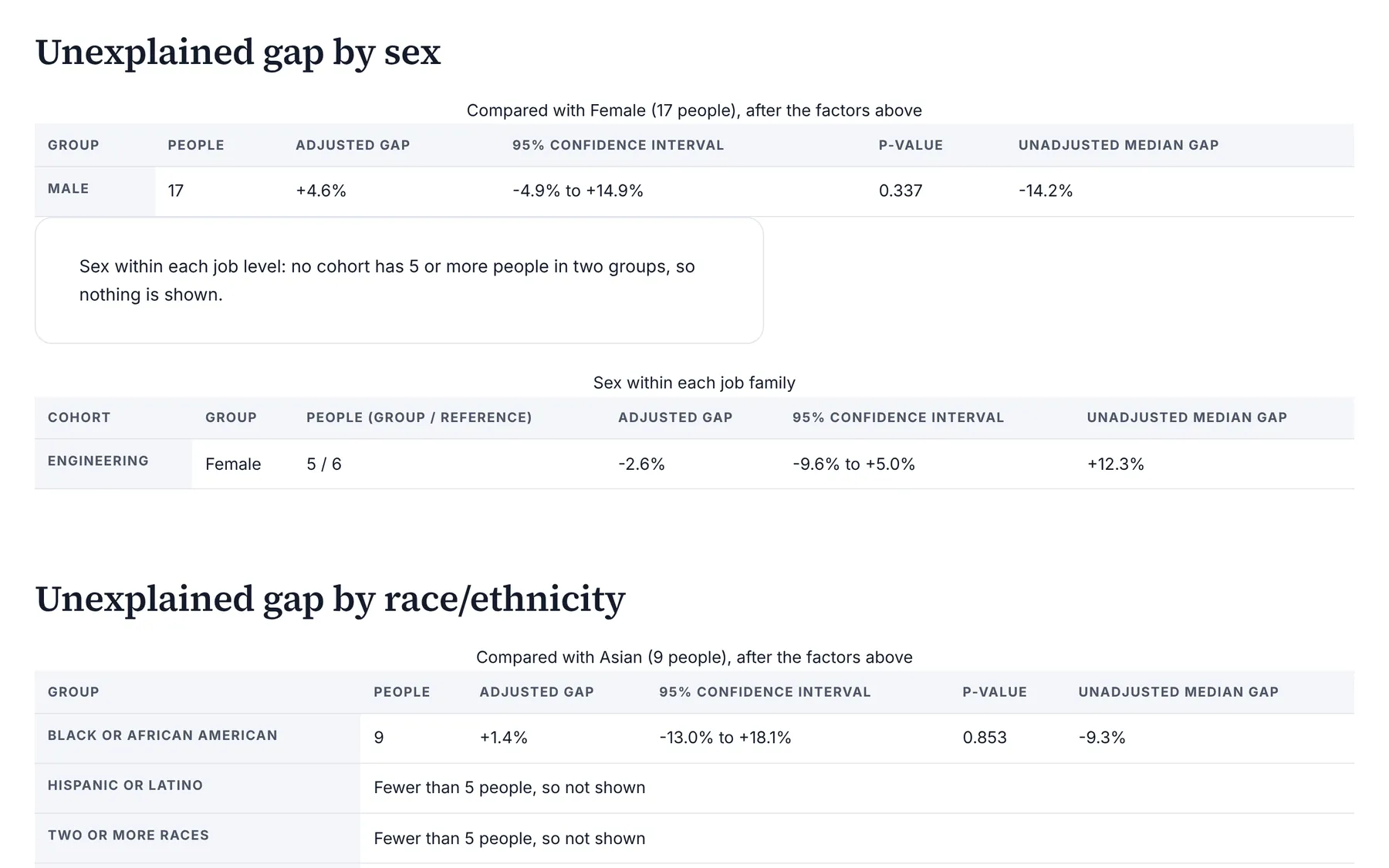
- Reports the adjusted gap for each sex and race/ethnicity group against the largest group, as a percentage with a 95% confidence interval and a p-value, next to the unadjusted median gap.
- Compares groups within each job level and each job family, using the model's residuals and a Welch confidence interval.
- Flags individuals paid below the low end of a 90% prediction interval from the base model, which has no demographics in it, so a flag never depends on anyone's group.
- Exports the results as a CSV that carries the same not-legal-advice note.
What it costs: Included on every Organization Viewer plan, including Free for up to 50 people. Paid plans start at $300 a month for 51 to 250 people. See pricing.
How it works, step by step
- Give people their pay, hire date, location and, if you use them, performance ratings in Organization Viewer, by hand or with the CSV import.
- Give roles a job level and job family in Job architecture.
- Record sex and race/ethnicity where people have chosen to self-identify.
- Open Pay equity, read the adjusted gaps and cohort comparisons, and download the report.
Feature details
How the gap is calculated
- Adjusted gap = exp(b) - 1, where b is the group's coefficient in the model; the 95% interval uses the Student t distribution.
- Unadjusted gap = the group's median pay divided by the reference group's median pay, minus 1.
- A group is reported only when it and the reference group each have at least 5 people; no model is reported with fewer than 10 residual degrees of freedom.
- The 90% review threshold is a choice made for this page, not a legal or industry standard.
Who can see it
- Only owners and admins who may see both pay and demographic data can open the page.
- A pay flag is never shown with anyone's demographics.
- Smaller groups stay in the model so they don't distort the reference group, but their results show only as fewer than the minimum.
Part of Organization Viewer's HR and workforce analytics
This is one of five analyses that read the same org chart, with the same privacy rules and no extra cost. The others:
- Employee turnover risk analysis: Attrition analytics is an Organization Viewer tool that measures where people are leaving, by department, manager and tenure band, and shows an explainable turnover risk signal built from named factors, not a prediction about any person.
- Hiring funnel analytics: Hiring funnel analytics is an Organization Viewer tool that turns an applicant-tracking export into stage conversion and drop-off, time to hire, offer acceptance, source quality and an adverse-impact check at every stage.
- Employee engagement survey analysis: Engagement survey analysis is an Organization Viewer tool that scores each area of a pulse or imported survey, checks how consistent each set of questions is with Cronbach's alpha, compares groups, counts comment themes and suggests where to start.
- AI hiring bias audit calculations: AI hiring bias audit calculations are an Organization Viewer tool that works out selection or scoring rates and impact ratios for an AI hiring tool by sex, race/ethnicity and both together, the way New York City's rules for Local Law 144 set out, with a draft summary for your independent auditor.
See Organization Viewer, or create a free account and load the fictional sample company to try every analysis before entering real data.
Get expert help: an I-O psychology consultant can run this analysis with you in the Pay and Fairness module (Sum of parts $58,000; bundle $52,000 (save 10%)).
Questions
What is a pay equity analysis?
A review of whether people doing comparable work are paid comparably once legitimate factors are accounted for. It usually uses regression to separate the gap those factors explain from the gap they don't.
What is the difference between the adjusted and unadjusted pay gap?
The unadjusted gap compares median pay between groups with nothing taken into account. The adjusted gap is what remains after job level, job family, tenure, location and performance are held constant in the model.
Is the result a legal finding?
No. It is a statistical screen and general information, not legal advice. A gap can have explanations the model doesn't include, and a lack of one doesn't rule out a problem. Review results with counsel.
How small can a company be?
The model needs at least 10 residual degrees of freedom, and a group needs 5 or more people to be reported. Below that, the page says so instead of showing a figure.
Does it cost extra?
No. It is included on every Organization Viewer plan.
Learn more
Help articles
Related consulting
Related features
- Pay transparency tracker
- AI hiring tool inventory
- Manager and 360 surveys
- Headcount budget planner
- Directory sync and chat alerts
- Attrition analytics
- Hiring funnel analytics
- Engagement survey analysis
- AI hiring bias audit calculations
- Booking and review requests
- Structured interview scorecards
- Job analysis wizard
- Onboarding plans
- Adverse-impact checker
- Requisitions
- Offer and pay-range check
- Goals and check-ins
- Review cycles
- 9-box calibration
- Team health dashboard
- Workforce analytics tools
Start with the sample, or with your own org
Sign-in is a one-time email link, with no password and no credit card. Load the fictional sample company to see every feature working before you enter real data.