
Performance review cycles with a fairness check
Review cycles is an Organization Viewer tool that pairs a short self review with a manager review on a behaviorally anchored scale, shows them beside 360 results, and checks the ratings for fairness.
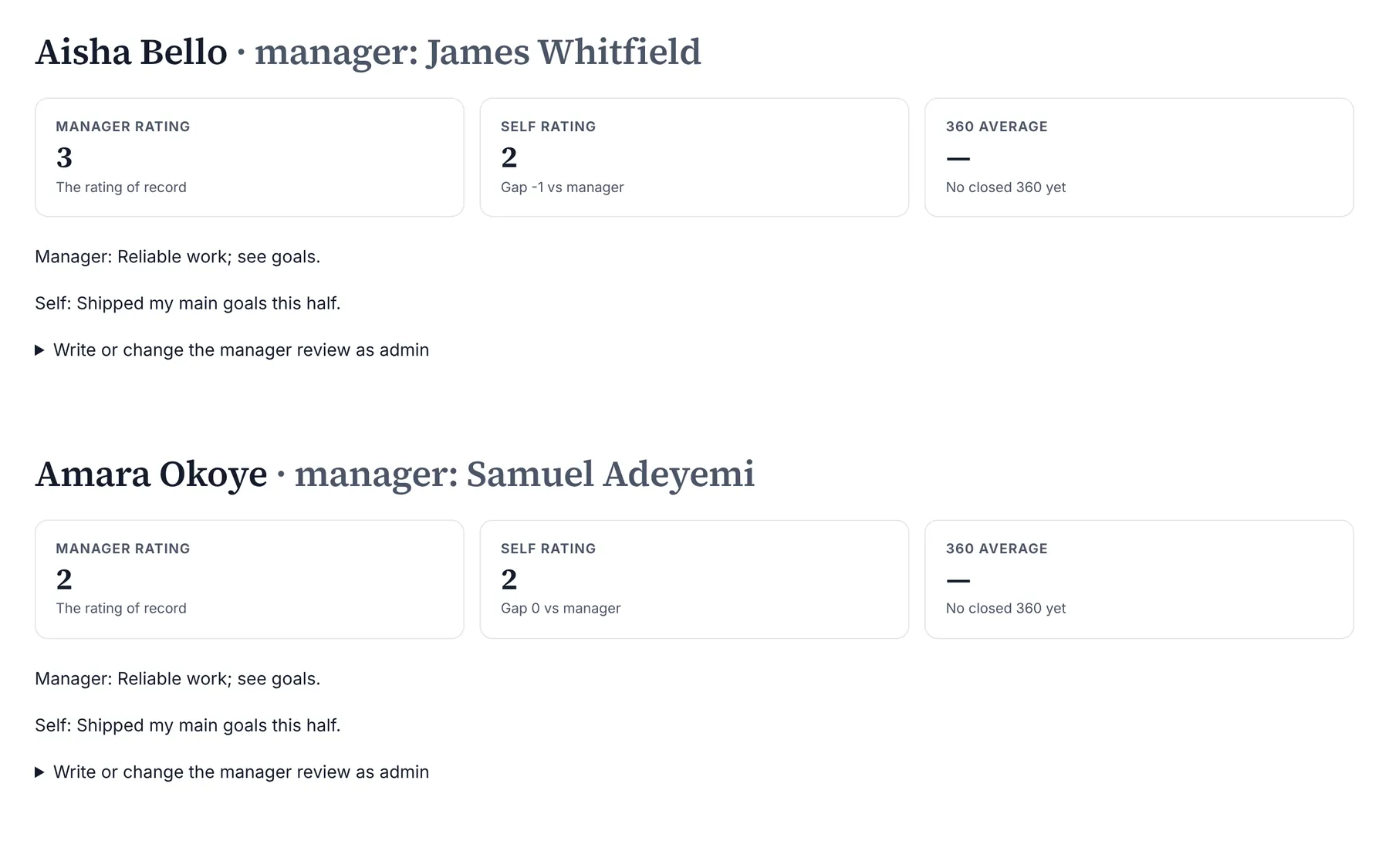
A review cycle asks each person for a short self review and their manager for a manager review, on the same 1 to 5 scale. Owners and admins see both next to the person's latest 360 results.
A fairness check then shows how ratings spread by group and by manager. Groups with fewer than 5 people are hidden.
Who is this for?
- HR teamsYou’ll use it to run a light review without a separate performance system, and see where ratings may be uneven.
- LeadersYou’ll use it to spot managers who rate everyone high or low before ratings drive pay or promotion.
Watch how it works
A 1:37 walkthrough with English captions and a transcript. The full written guide is in the help center.
Transcript (1:37 video, captions in English)
- How to: run a review cycle
- WHAT IT'S FOR: Self and manager reviews on one anchored 1 to 5 scale, with a fairness check
- What you need first. Managers set on the org chart. Work emails on people. An owner or admin to start it
- STEP 1: Under Start a cycle, name it, choose Who, Start cycle. Everyone on the org chart, or one department
- STEP 2: Each person: rating, examples, Save self review
- STEP 3: Each manager: rating, evidence, Save manager review. The self review shows only after the manager saves
- STEP 4: Read the Fairness check. Managers well away from everyone else are flagged
- STEP 5: Ratings by group. Under 0.8 is the four-fifths rule of thumb; groups under 5 hidden
- STEP 6: Then select Close cycle. Closing shows each person their manager's review
- NOT LEGAL ADVICE: A prompt to look closer. Not a finding of discrimination, and not a bias audit
- Summary. Start the cycle. Self, then manager reviews. Fairness check, then close
- Full guide: blisspointanalytics.com/help/review-cycles
What it does
- A behaviorally anchored rating scale (BARS): every point from 1 to 5 describes the work behind it, so raters are more consistent.
- Independent ratings: the manager sees the self review only after saving their own rating.
- Self, manager and 360 results side by side. The manager's rating is the rating of record; the self rating and 360 are context and are never averaged in.
- A fairness check by department, job level and, where voluntary self-identification is on, sex and race/ethnicity.
- Managers whose ratings are much more lenient or severe than everyone else's are flagged for a closer look.
What it costs: Included on every Organization Viewer plan, including Free for up to 50 people. Paid plans start at $300 a month for 51 to 250 people. See pricing.
How it works, step by step
- An owner or admin opens Review cycles and starts a cycle for everyone or one department.
- Each person saves a self review; each manager saves a manager review.
- Owners and admins read the fairness check, discuss the differences, then close the cycle so each person sees their manager's review.
Feature details
The fairness check, exactly as it works
- Any group with fewer than 5 people is hidden, and so is one more group when the hidden ones could be worked out from the total.
- The share of each group rated 4 or 5 is divided by the highest group's share. A ratio under 0.8 is the four-fifths rule of thumb from the Uniform Guidelines on Employee Selection Procedures (29 CFR 1607.4(D)): a prompt to look closer, not a finding of discrimination.
- A manager who rated at least 5 people is flagged when their average differs from all other ratings by 0.75 points or more and by at least half a standard deviation.
- When ratings feed decisions such as promotion, the Uniform Guidelines expect what is rated to come from an analysis of the job, so tie the scale to the role's real duties.
- New York City Local Law 144 applies to automated employment decision tools in hiring and promotion; see the AI hiring tool inventory. This check is not a bias audit. General information, not legal advice.
Questions
Can the manager see the self review first?
No. The manager sees it only after saving their own rating, so the two are made independently.
Is the fairness check a bias audit?
No. It is a prompt for discussion in calibration. A bias audit under New York City Local Law 144 needs an independent auditor.
When does a person see their manager's review?
When an owner or admin closes the cycle.
Learn more
Help articles
Related consulting
Related features
- Pay transparency tracker
- AI hiring tool inventory
- Manager and 360 surveys
- Headcount budget planner
- Directory sync and chat alerts
- Attrition analytics
- Pay equity analysis
- Hiring funnel analytics
- Engagement survey analysis
- AI hiring bias audit calculations
- Booking and review requests
- Structured interview scorecards
- Job analysis wizard
- Onboarding plans
- Adverse-impact checker
- Requisitions
- Offer and pay-range check
- Goals and check-ins
- 9-box calibration
- Team health dashboard
- Workforce analytics tools
Start with the sample, or with your own org
Sign-in is a one-time email link, with no password and no credit card. Load the fictional sample company to see every feature working before you enter real data.