
Employee engagement survey analysis, with anonymity built in
Engagement survey analysis is an Organization Viewer tool that scores each area of a pulse or imported survey, checks how consistent each set of questions is with Cronbach's alpha, compares groups, counts comment themes and suggests where to start.
Collecting survey answers is the easy part. Reading them well means knowing which areas score low, whether a set of questions measures one thing consistently, how groups differ, what people wrote about, and where to start. Organization Viewer does that for its own pulse surveys and for results imported from another survey tool.
Every result follows the pulse survey confidentiality rules: nothing is shown for a group of fewer than 5 responses, and comments are summarized only when at least 10 people answered.
Who is this for?
- HR and people teamsYou’ll use it to turn survey answers into a short list of areas to act on, with the method shown.
- ManagersYou’ll use it to see where your team scores low without anyone's answers being singled out.
- Companies using another survey toolYou’ll use it to import results for the same analysis; imports are analyzed in memory and not stored.
What it does
- Works on a 1 to 5 agreement scale, where 4 or 5 counts as favorable.
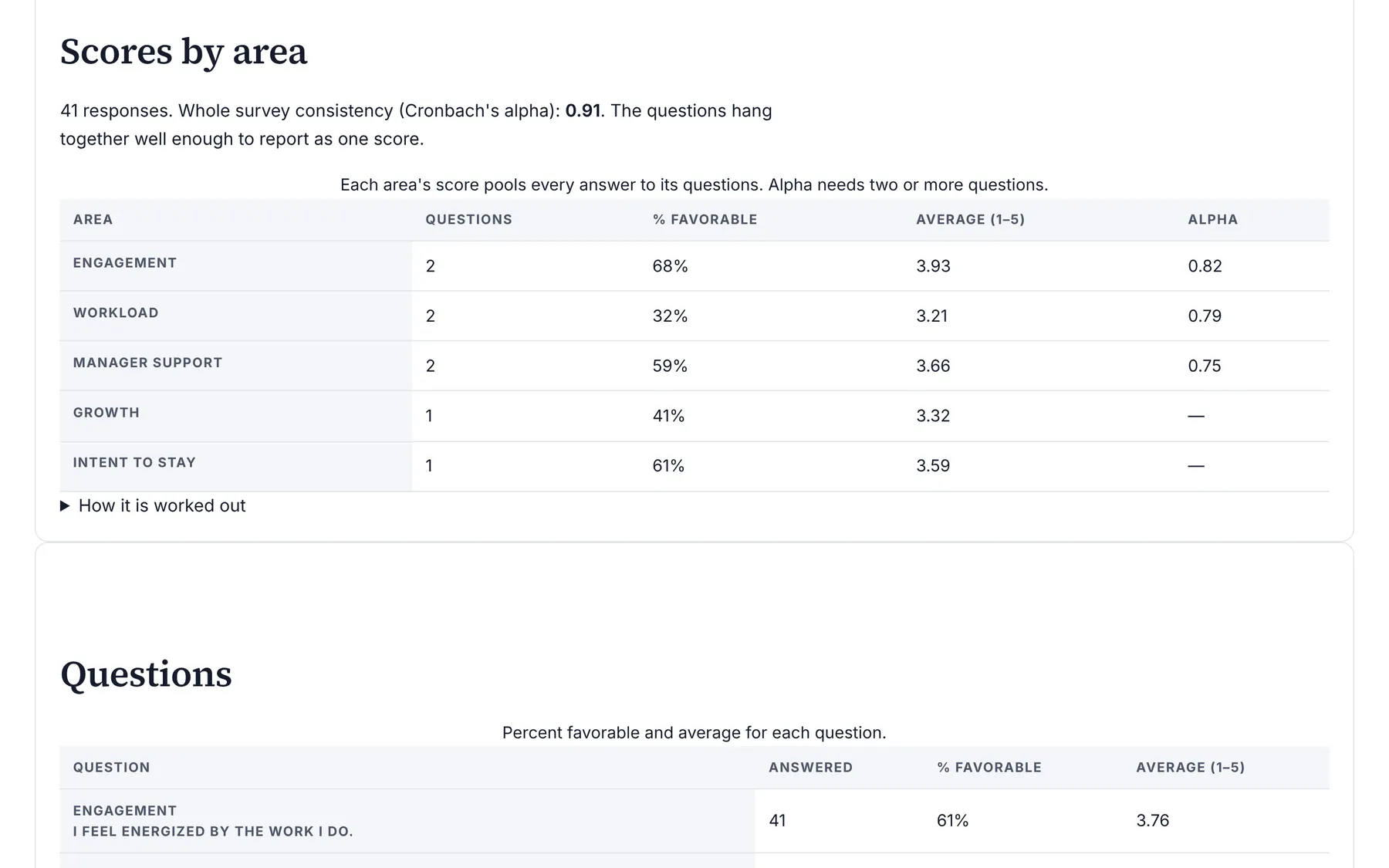
- Shows percent favorable for each question, and a score and percent favorable for each area (a set of questions).
- Reports Cronbach's alpha for each area with two or more questions, with 0.70 shown as a widely used rule of thumb (Nunnally, 1978), not a pass or fail line.
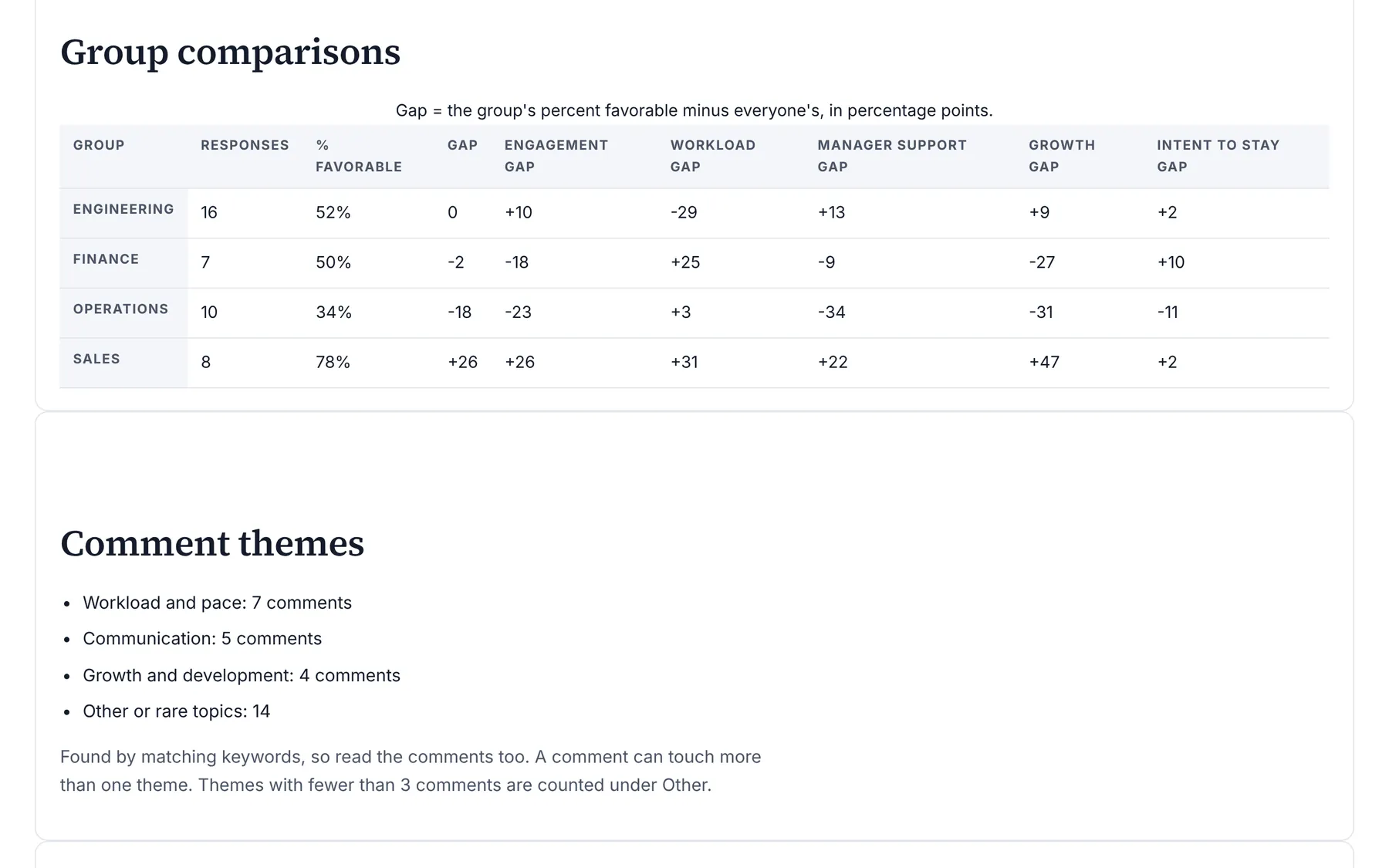
- Compares each group's percent favorable with everyone's in percentage points, hiding groups under 5 responses and any group that could be worked out by subtraction.
- Counts open-text comments by theme (such as workload, manager, communication, pay and growth) from a fixed keyword list; a theme with fewer than 3 comments is folded into Other.
- Suggests plain-language action ideas for the lowest-scoring areas.
What it costs: Included on every Organization Viewer plan, including Free for up to 50 people. Paid plans start at $300 a month for 51 to 250 people. See pricing.
How it works, step by step
- Run a pulse survey in Organization Viewer and close it, or open Analyze survey results and import a CSV from another survey tool.
- Read the area scores and favorability, with the reliability figure for each area.
- Compare groups and read the comment themes.
- Pick one or two areas and use the action ideas to plan next steps with managers.
Feature details
Formulas
- Item percent favorable = favorable answers divided by answers to that question.
- Area score = the mean of every answer to the area's questions.
- Cronbach's alpha = k / (k - 1) x (1 - sum of item variances / variance of the total score), on people who answered every question in the area.
What to keep in mind
- Use only questions you have the right to use: your own or openly licensed ones.
- Keyword themes are counts, not a reading of meaning; read a sample of comments before drawing conclusions.
- A survey shows how people answered on the day, not why; follow up with conversations.
Part of Organization Viewer's HR and workforce analytics
This is one of five analyses that read the same org chart, with the same privacy rules and no extra cost. The others:
- Employee turnover risk analysis: Attrition analytics is an Organization Viewer tool that measures where people are leaving, by department, manager and tenure band, and shows an explainable turnover risk signal built from named factors, not a prediction about any person.
- Pay equity analysis software: Pay equity analysis in Organization Viewer is a regression-based audit that estimates the pay gap left unexplained by job level, job family, tenure, location and performance, for each sex and race/ethnicity group, with confidence intervals.
- Hiring funnel analytics: Hiring funnel analytics is an Organization Viewer tool that turns an applicant-tracking export into stage conversion and drop-off, time to hire, offer acceptance, source quality and an adverse-impact check at every stage.
- AI hiring bias audit calculations: AI hiring bias audit calculations are an Organization Viewer tool that works out selection or scoring rates and impact ratios for an AI hiring tool by sex, race/ethnicity and both together, the way New York City's rules for Local Law 144 set out, with a draft summary for your independent auditor.
See Organization Viewer, or create a free account and load the fictional sample company to try every analysis before entering real data.
Get expert help: an I-O psychology consultant can run this analysis with you in the People Insight module (Sum of parts $41,800; bundle $37,500 (save 10%)).
Questions
What does percent favorable mean?
The share of answers that were 4 (Agree) or 5 (Strongly agree) on the 1 to 5 scale.
What is Cronbach's alpha?
A measure of how consistently a set of questions moves together. Values of 0.70 or higher are a common rule of thumb for acceptable consistency; it is not a pass or fail test.
Can anyone see one person's answers?
No. Groups with fewer than 5 responses are hidden, so is any group that could be worked out by subtraction, and comment themes appear only when at least 10 people answered.
Can I analyze results from another survey tool?
Yes. Import a CSV of answers on the 1 to 5 scale. The results are analyzed in memory and not stored.
Does it read the comment boxes, not just the scores?
Yes. Every engagement survey has comment boxes, and HR teams want the themes in them. It counts open-text comments by theme (workload, manager, communication, pay, growth and others) once at least 10 people answered, at no extra cost on any plan, including free. For a full read of the comments, with whether each theme reads positive or negative, see the Employee Engagement Survey Program.
Does it cost extra?
No. It is included on every Organization Viewer plan.
Learn more
Help articles
Related consulting
Related features
- Pay transparency tracker
- AI hiring tool inventory
- Manager and 360 surveys
- Headcount budget planner
- Directory sync and chat alerts
- Attrition analytics
- Pay equity analysis
- Hiring funnel analytics
- AI hiring bias audit calculations
- Booking and review requests
- Structured interview scorecards
- Job analysis wizard
- Onboarding plans
- Adverse-impact checker
- Requisitions
- Offer and pay-range check
- Goals and check-ins
- Review cycles
- 9-box calibration
- Team health dashboard
- Workforce analytics tools
Start with the sample, or with your own org
Sign-in is a one-time email link, with no password and no credit card. Load the fictional sample company to see every feature working before you enter real data.